The challenge of maintaining a profitable law practice is significant. While providing expert legal services is paramount, strategic fiscal management often determines long-term success and partner security. Partners require actionable, real-time data to drive firm-wide decisions, moving beyond static year-end reports.
This essential guide identifies the eight most critical Financial Key Performance Indicators (KPIs) that every law firm partner in England and Wales must track to achieve robust financial health and secure strategic growth. Monitoring these metrics is not optional; it is fundamental to governing a successful UK legal practice.
The Financial Imperative: Why Law Firms Must Adopt KPI Reporting
Law firms operate on complex financial models, combining client money management, staff productivity, and rigorous regulatory oversight. Relying solely on bank balances or basic profit-and-loss statements creates significant financial blind spots. Strategic partners utilise KPIs to look beneath the surface, enabling them to diagnose potential issues decisively before they escalate and affect core profitability or regulatory compliance.
Operational vs. Financial Metrics: Defining the Strategic Focus
Partners must clearly distinguish between daily activity metrics and the core financial indicators that drive profit and secure cash flow.
Metric Type
Focus
Role in Decision Making
Operational Metrics
Daily activity and output (e.g., number of new client enquiries, average response time).
Shows what the firm does and monitors service quality.
Shows how profitably the firm converts effort into income and governs capital.
Why prioritise Financial KPIs? They provide the leverage required to optimise the business model. Tracking these metrics enables firms to:
Identify bottlenecks where revenue stalls.
Ensure sufficient working capital actively supports expansion.
Transform fiscal management from a reactive exercise into a proactive strategy.
Compliance and Strategy: Navigating the UK Regulatory Context
The regulatory environment for legal practices in the UK is stringent, necessitating robust internal financial controls. Financial KPIs serve as an essential early warning system for compliance issues, ensuring the firm adheres to strict professional standards.
SRA Accounts Rules Requirements: Rigorous monitoring of Work in Progress (WIP) and Debtors helps partners maintain the required segregation of client money from office money. This diligence is essential for compliance with the Solicitors Regulation Authority (SRA) Accounts Rules, protecting client funds and the firm’s standing.
Tax Planning and HMRC: Accurate tracking of income and expenses through KPIs ensures the firm reserves adequate funds to meet statutory deadlines for HMRC payments. Proactive monitoring mitigates the risk of penalties and avoids sudden cash flow demands.
The First Four: Metrics Governing Fee Earner Efficiency and Revenue Conversion
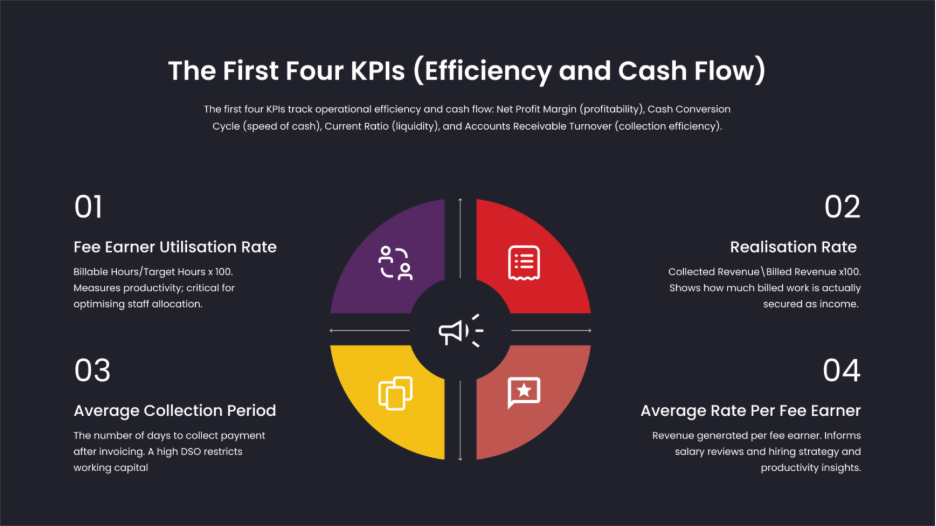
These initial metrics focus on the efficiency of the fee-earning process and the speed at which billable work is converted into cash. They are the bedrock of any profitable practice.
This KPI measures the amount of time fee earners spend on billable work compared to their total available hours. It is the primary measure of internal efficiency.
Strategic Application: Partners must use this data to precisely assess the efficiency of solicitors and support staff. A consistently low utilisation rate signals a need to either review case allocation, improve marketing strategies for client generation, or address non-billable administrative inefficiencies.
2. Realisation Rate (or Collection Rate)
The Realisation Rate measures how much of the billed work the firm successfully collects payment for. It directly addresses the gap between work performed and revenue secured.
Strategies to Secure Payment: Partners must scrutinise this rate to identify reasons for write-offs or discounts. Strategies for improvement involve ensuring robust engagement letters are in place, actively managing client expectations to avoid disputes upon billing, and implementing strict quality checks on billing records to ensure accuracy.
3. Average Collection Period (Days Sales Outstanding – DSO)
DSO measures the average number of days it takes for a firm to receive payment after issuing an invoice. A low DSO is crucial for immediate liquidity and optimal cash flow management.
Impact on Working Capital: High DSO critically ties up vital cash that the firm needs for salaries, operational investments, or partner drawings. A long collection period is a significant anchor on profitability, regardless of the firm’s utilisation rate.
Actionable Steps: Firms must implement prompt, automated invoicing systems immediately upon matter completion. Establishing clear, proactive follow-up procedures for overdue accounts and offering convenient payment options are essential steps to driving this figure down.
4. Average Rate Per Fee Earner (ARPF)
ARPF calculates the average revenue generated by each fee earner, providing a granular measure of overall productivity and financial contribution across the firm.
Key Insight: This metric informs staffing and salary decisions by calculating the true revenue generation per individual, regardless of their specific charge-out rate.
Application: ARPF provides an objective basis for performance reviews, helps justify strategic specialist hiring, and supports investment in training that elevates fee earner output.
Metrics for the Partnership: Controlling Costs and Maximising Equity
The final four KPIs provide a macro view of the firm’s financial sustainability, focusing on expense management and the effectiveness of the partnership structure itself. These metrics directly govern partner value and firm longevity.
5. Operating Profit Margin
This KPI shows the percentage of revenue remaining after deducting operating expenses, excluding tax and interest. It is the clearest indicator of core business efficiency before statutory deductions.
Strategic Requirement: Partners must regularly benchmark their operating margin against UK legal sector data to ensure the firm remains competitive and fiscally sound. A declining margin suggests that operational costs are growing faster than revenue, requiring immediate expense control measures.
This metric is essential for evaluating the effectiveness and financial value generated by the firm’s leadership and management structure.
Purpose: It holds partners accountable for generating and supporting profitable work across the firm.
Governance: Provides objective, verifiable data for determining partner compensation, managing equity, and structuring profit-sharing agreements fairly and transparently.
7. Lock-up
Lock-up is the most crucial cash flow KPI for UK law firms. It represents the total amount of money tied up in the billing cycle, work completed but not yet paid for effectively frozen until collection.
Defining Lock-up: The combined total of Work in Progress (WIP) and Debtors (unpaid invoices).
The Goal: Partners must aim to minimise the lock-up period (measured in days). The faster the firm converts service into cash, the sooner liquidity improves, freeing up funds for strategic investment.
8. Overhead Cost Per Fee Earner
This KPI tracks the total non-billable costs required to support each fee earner, providing insight into cost efficiency. Partners must allocate indirect costs accurately to understand profitability.
Variable Costs: Marketing spend, consumables, non-essential travel, or entertainment.
Importance: High overhead per fee earner can significantly erode profit margins, even if utilisation rates are high. Controlling these costs is vital to ensure that revenue translates into meaningful partner profits.
Beyond the Numbers: Using KPIs to Drive Strategic Decisions
Measurement alone is insufficient. Successful law firms leverage KPI analysis to implement decisive operational changes that enhance profitability, efficiency, and market positioning.
Using KPI Trends for Value-Based Pricing Decisions
Financial data must inform how the firm prices its services, justifying a move beyond outdated hourly rate models
KPI Data Insight
Strategic Pricing Action
High ARPF in specific practice areas.
Justify higher hourly rates or shift to value-based billing in that speciality, recognising high-value delivery.
Low Realisation Rate due to disputes.
Implement clearer fixed-fee agreements upfront or scope limitations to manage client expectations and mitigate write-offs.
Fluctuating Utilisation across teams.
Use data to redistribute lower-margin work or adjust team charge-out rates for better market alignment and efficiency.
Accounting Support: Ensuring Compliance and Clarity
Law firms require specialist fiscal management that understands the dual nature of their finances: commercial profitability and client money security.
SRA Compliance: Specialist accountants ensure all financial processes and software integrate seamlessly to meet the stringent requirements of the SRA Accounts Rules, protecting the firm and its partners from regulatory risk.
Digital Integration: Expertise in UK-compliant digital accounting systems ensures accurate, real-time KPI generation alongside seamless HMRC reporting required under Making Tax Digital (MTD) rules, creating a sole source of financial truth.
Partner with AZL: Specialist Accounting for Law Firms in England and Wales
Law firm partners face unique and evolving financial pressures. Effectively managing cash flow, achieving high profitability targets, and maintaining rigorous SRA compliance requires specialist financial expertise. The expert accountants at AZL bring deep, focused experience, providing clarity and decisive fiscal management tailored specifically to the UK legal sector.
Our professional, authoritative support ensures your firm’s financial strategy aligns perfectly with regulatory demands and growth ambitions. Our commitment is exclusively to the firms of England and Wales, providing the essential localised expertise that protects your capital and secures your future.
Do not let vital financial data remain untapped. Contact AZL today to schedule a strategy consultation and put your practice on the path to sustained, compliant profitability.
Law firm partners and practice managers across England and Wales face constant regulatory pressure. Managing Value Added Tax (VAT) correctly, especially regarding client fees and the accurate definition of a disbursement presents a major financial and regulatory exposure. Misclassification on an invoice...
Unidentified funds entering your legal firm’s accounts create an immediate regulatory and financial risk. In the highly regulated environment of England and Wales, where Solicitors Regulation Authority (SRA) Accounts Rules govern every transaction, a simple bank receipt with an unknown source can jeopardise your Trial Balance and compliance standing. Law firms require an...
For law firm partners and practice managers in England and Wales, managing client finances securely and compliantly presents a persistent, high-stakes challenge. The integrity of your firm hinges on impeccable financial record-keeping. You need clarity and confidence in every transaction, ensuring you satisfy the rigorous demands of the Solicitors Regulation Authority (SRA) while maintaining profitable operations. AZL Accountants provides the specialist expertise your firm needs....






 3 July 2026
 1 July 2026