Making Tax Digital is shifting how UK businesses and landowners record and report their taxes rather than depending on single annual Self-assessment. Now, many taxpayers will submit continuous digital updates by using the HMRC-approved software. Therefore, this guide explains who can join the MTD for VAT and ITSA, the phased start dates, what ‘digital record-keeping’ and the Digital Link principle mean in practice, and the major steps for preparation. If you are currently using the paper records or spreadsheets, you’ll know which processes to change, the selection of a reliable software, and how AZL assist you in registration, software setup, and timely reporting so can avoid fines and keep control of cash flow.
What Is Making Tax Digital (MTD) and Its Purpose?
Making Tax Digital (MTD) is HMRC’s plan to replace annual, paper-based tax reporting with regular digital submissions for certain taxes, initially VAT and now extending to Income Tax (ITSA) for many sole traders and landlords. Under MTD, taxpayers in scope must create and retain digital records of transactions and submit tax data to HMRC using functional-compatible software. That requires software (or approved bridging tools) that maintains a ‘digital link’ from your records to the submission, avoiding manual copy-and-paste processes.
The Digital Mandate: Moving Beyond Paper
MTD means you can no longer rely on piles of paper or tedious manual data entry. HMRC’s goal is a straightforward digital process. You must digitally record every transaction at the time it occurs, typically using dedicated accounting software or a spreadsheet connected to ‘bridging’ software. Keep your paper receipts if you like but remember they must have a digital backup. The main rule to remember manual copy-pasting, retyping, or moving data between systems is a strict ‘no-no.’ That breaks the crucial ‘Digital Link’ rule and will land you in trouble .
Legal Framework: Statutory Authority and Goal
MTD isn’t optional; it’s the law! It was made a statutory requirement under the powers granted by the Finance (No. 2) Act 2017.. This Act essentially gives HMRC the legal authority to say, “You must keep digital records and submit your taxes this way.” It provides the legal foundation for MTD for VAT, and soon for ITSA, forcing businesses and landlords to send regular quarterly updates. The big win here? By integrating reporting into your everyday business tasks, HMRC aims to drastically reduce those human errors and make tax compliance easier for everyone.
Core Objective: Closing the ‘Tax Gap
HMRC’s strategy aims to reduce errors caused by manual data entry by requiring businesses and landlords to record transactions digitally. This allows taxpayers to monitor their tax position throughout the year rather than waiting until the end of the tax period. By requiring regular digital reporting, MTD helps HMRC collect the correct amount of tax and reduces the so-called ‘tax gap’. It also encourages businesses to embed tax reporting into everyday accounting tasks, such as recording sales and expenses digitally, so compliance becomes part of routine operations rather than a year-end burden.
MTD first became mandatory for VAT-registered businesses with a taxable turnover above the VAT threshold. However, from April 2022, all VAT-registered businesses, irrespective of turnover, must comply with MTD rules.
Mandatory Start Date for All VAT-Registered Businesses
Every business registered for VAT must adhere to the MTD rules. You must use functional compatible software to keep digital records and submit VAT Returns directly to HMRC. This completely replaces the old method of manually inputting figures onto the Government Gateway portal.
Approved Software Requirements for VAT Submissions
You must use software that can both store the mandatory data digitally and create a ‘digital link’ to send the final VAT figures to HMRC. Spreadsheets are still permissible, but only if they are integrated with ‘bridging software’ to create the necessary digital link for the final submission.
MTD for ITSA: The Biggest Change for Sole Traders and Landlords
MTD for Income Tax Self-Assessment (ITSA) constitutes the most profound change to the UK tax regime for sole traders and landlords in decades. It replaces the single annual Self-Assessment tax return with five mandatory digital submissions per tax year.
The Phased Rollout of MTD for ITSA
The introduction of MTD for ITSA is being phased in based on an individual’s total qualifying income from self-employment and property letting.
Phased Mandatory Dates for MTD for ITSA
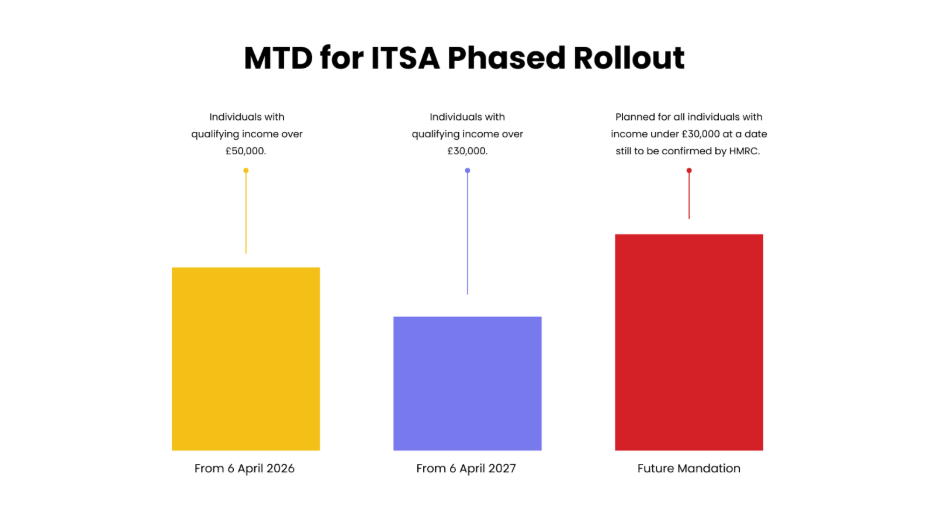
MTD for ITSAwill be phased in based on an individual’s total qualifying income:
1. From 6 April 2026: For individuals with qualifying income over £50,000.
2. From 6 April 2027: For individuals with qualifying income over £30,000.
Note: Future Mandation: MTD for ITSA is planned for all individuals with income under $£30,000 at a date still to be confirmed by HMRC.
Who Is Included: Sole Traders and Landlords?
The new MTD for ITSA rules apply to individuals who are:
Sole Traders with income from self-employment.
UK Landlords receiving income from property letting.
If you have income from both sources, HMRC combines the gross totals to determine if you meet the threshold for mandation.
Key Changes to Reporting and Submissions
The compliance cycle fundamentally changes under MTD for ITSA, moving to a four-quarter reporting model that demands consistent attention to detail.
Quarterly Updates: The New Reporting Cycle
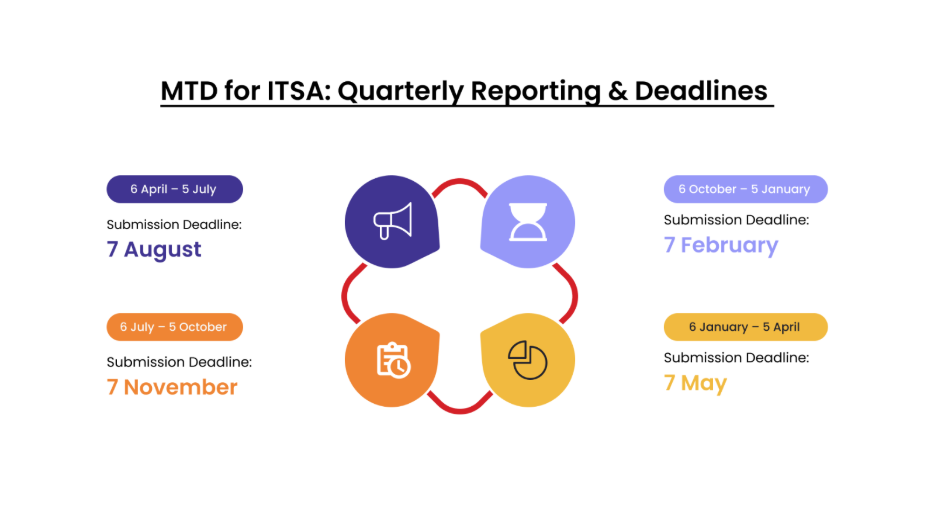
Instead of one annual filing, MTD requires you to send four Quarterly Updates to HMRC. These updates summarise your income and expenses for the period using your compatible software.
The standard quarterly periods and their deadlines are:
Period Covered
Submission Deadline
6 April – 5 July
7 August
6 July – 5 October
7 November
6 October – 5 January
7 February
6 January – 5 Apri
7 May
You must submit these updates, or have your agent submit them, by the deadline to avoid potential penalties.
Final Declaration: Replacing the Annual Self-Assessment
After the four quarterly updates, you must submit a Final Declaration by the following 31 January. This submission consolidates the quarterly figures, incorporates any final adjustments, non-MTD income sources (like interest or dividends), and formally declares the final tax position for the year. This final submission effectively replaces the annual Self-Assessment (SA100) form.
The Role of ‘End-of-Period Statements’ (EOPS)
The End-of-Period Statement (EOPS) completes the final submission process. The EOPS confirms that the quarterly figures are correct and include any accounting adjustments, such as claiming capital allowances or calculating accruals and prepayments for the tax year.
Essential MTD Compliance: Three Steps to Preparation
Preparation is key to a smooth transition. Businesses that prepare early minimise disruption and gain control over their digital reporting obligations.
Choosing MTD-Compliant Software
The foundation of MTD is the software you use. It must be capable of fulfilling HMRC’s dual requirements: digital record-keeping and digital submission.
HMRC’s List of Recognised Software Providers
You must select functional compatible software that has been specifically recognised by HMRC. This software directly connects to HMRC’s systems for tax submission. Options range from full cloud-based accounting platforms to simpler spreadsheet-based ‘bridging software’
Linking Software to HMRC (The Digital Handshake)
Your chosen software must be authorised to communicate directly with HMRC on your behalf. This involves a secure digital process where you authorise the software to retrieve and submit your tax data. This digital handshake ensures the security and authenticity of your submissions.
The Mandate for Digital Record Keeping
MTD standardises the minimum data you must record for every transaction. These records must be held digitally within your compatible software.
The Digital Link Rule
The Digital Link Rule is critical. It mandates that data transfer between different software applications (e.g., from a spreadsheet to bridging software) must be automated. You must not copy and paste figures manually, as this breaks the digital link and violates MTD rules. This rule is designed to eliminate human transcription errors.
Minimum Data Requirements for Tax Records
You must digitally record the date, amount, and category of every transaction. The underlying digital record must contain the following details:
The total income was received.
The total expenditure incurred.
Specific details, such as the date and nature of the transaction.
For VAT-registered businesses: The VAT charged or claimed and the applicable VAT rate.
Registration Process and Time Limits
Registering for MTD for ITSA is a formal step that must be completed using the official HMRC service once you are within the scope of the rules.
How to Register for MTD for ITSA
You must register for MTD for ITSA via the official HMRC registration service. You should only register when you have secured MTD-compliant software and are ready to start reporting digitally, as you will be responsible for MTD reporting from your mandatory start date.
Common MTD Challenges and How AZL Provides Support
The transition to MTD requires time, investment, and procedural change. We address the most common client concerns directly by providing robust, expert-led solutions.
Ensuring Data Accuracy and Minimising Penalties
The shift to quarterly reporting increases the administrative burden and the risk of penalties if processes are not robust.
New Penalty System for Late Submissions
HMRC operates a Points-Based Penalty System (expanding to ITSA from April 2026) designed to penalise persistent non-compliance:
Late Submission: You accrue one penalty point for each late submission (Quarterly Update, EOPS, or Final Declaration).
Penalty Threshold: Reaching four penalty points triggers an initial £200 fine.
Late Payment Penalties: Separate charges apply for late tax payments, starting at a low percentage after 15 days overdue and escalating.
Preventing Errors in Quarterly Reports
Frequent reporting means frequent opportunity for mistakes. Implementing rigorous internal control systems, such as regular bookkeeping reviews, will help ensure:
Correct categorisation of income and expenses.
Accurate application of the Digital Link Rule.
Timely submissions to prevent penalty points from accruing.
Training and Transition Management
Many businesses struggle with the operational change of switching from familiar paper or spreadsheet systems to new software platforms.
Moving Away from Spreadsheets and Paper Records
We understand the challenge of retiring from traditional systems. Our experts provide a structured transition plan to help you move from manual spreadsheets and paper records to an efficient digital process. We set up your MTD-compatible software to mirror your business’s workflow, ensuring minimal disruption.
AZL’s Training and Setup Assistance for MTD Software
Our support goes beyond simple setup. AZL’s accountants deliver tailored training and setup assistance for your chosen MTD software. We ensure you and your team are confident in recording transactions, understanding the quarterly cycle, and preparing clean data for your mandatory updates. We act as your dedicated MTD specialist, ensuring continuous compliance.
Managing payroll in-house presents a significant challenge for London businesses. It demands considerable time, resources, and a constant vigil over the ever-changing landscape of UK payroll legislation. Errors or missed...
The concept of a four-day work week holds massive appeal for law firms in England and Wales, promising improved staff morale, reduced burnout, and a competitive edge in recruitment. However, implementing this major operational shift without financial preparedness creates significant risk. Viability demands precise accounting, sophisticated revenue modelling, and strict adherence to UK employment and tax law. Your...
Large-scale legal actions, managed in England and Wales as Group Litigation Orders (GLOs), present unique and immense financial challenges. These cases demand substantial upfront investment, span years, and involve intricate financial structures like Third-Party Litigation Funding (TPLF) and Conditional Fee Agreements (CFAs). Failing to correctly structure costs, manage cash flow, and ensure Solicitors Accounts...



 24 June 2025
 27 June 2026