Large-scale legal actions, managed in England and Wales as Group Litigation Orders (GLOs), present unique and immense financial challenges. These cases demand substantial upfront investment, span years, and involve intricate financial structures like Third-Party Litigation Funding (TPLF) and Conditional Fee Agreements (CFAs).
Failing to correctly structure costs, manage cash flow, and ensure Solicitors Accounts Rules (SAR) compliance can jeopardise the entire case and threaten your firm’s stability. AZL’s expert litigation accountants provide the definitive financial architecture necessary to secure financing, manage long-term risk, and correctly handle massive settlement distributions.
Phase 1: Structuring Costs and Architecting Financing
The success of any large action hinges on upfront financial planning. This includes the correct classification of expenses for tax and compliance purposes, and the complex accounting for external funding models unique to England and Wales.
Distinguishing Recoverable Costs and Disbursements
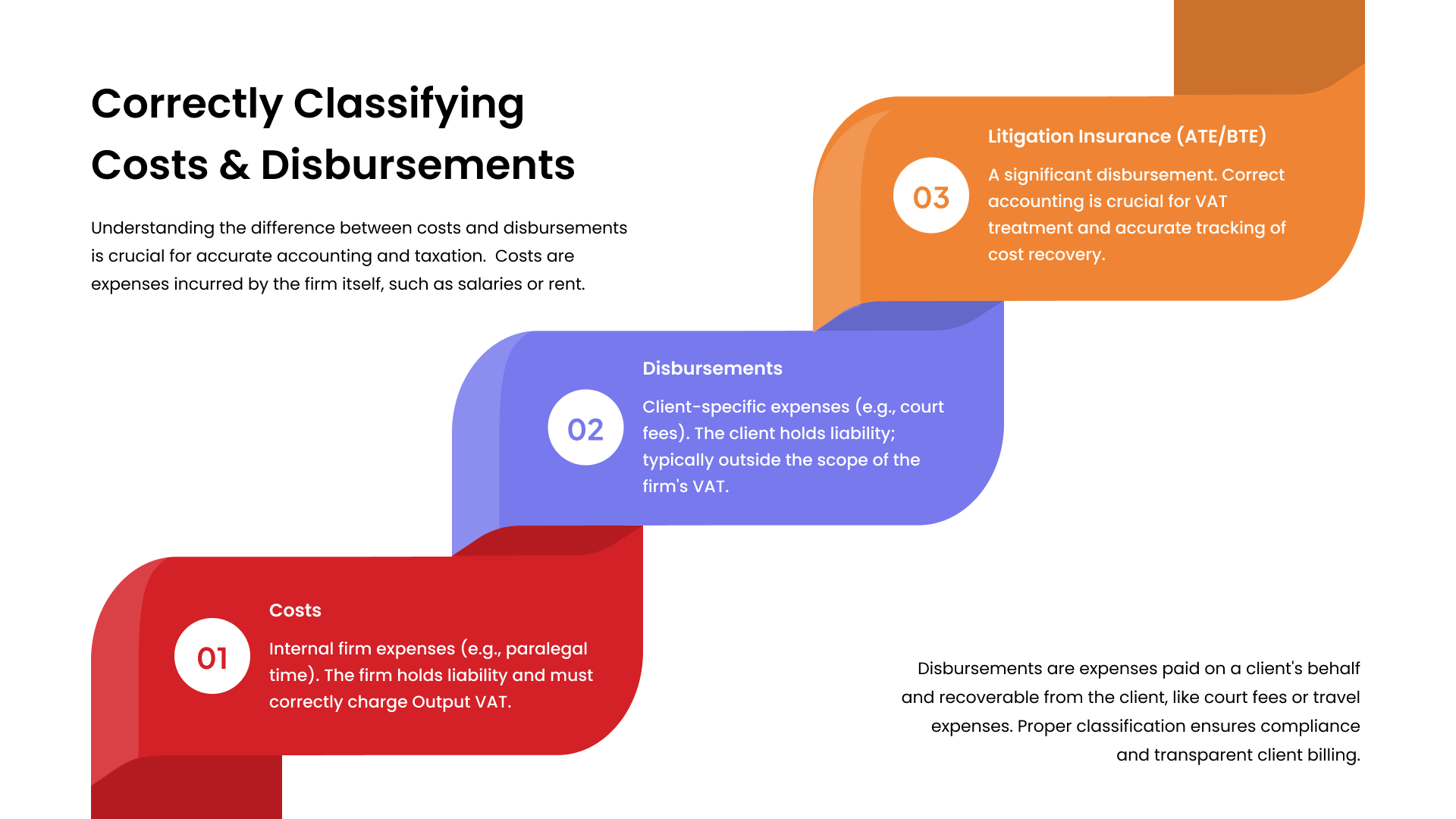
Correctly differentiating expenditures is fundamental for VAT (Value Added Tax) recovery, client billing, and SAR compliance. Our expertise averts costly accounting errors from the start.
Expense Type
Definition & Liability
VAT Treatment & AZL Focus
Costs
The firm’s internal operating expenses (e.g., in-house paralegal time, general research). The firm holds the primary liability.
Subject to the firm’s standard Output VAT as a supply if recharged to the client. We ensure this tax is correctly levied and reported.
Disbursements
Client-specific expenses paid by the firm acting as an agent (e.g., court fees, expert witness fees). The client holds the primary liability.
Typically, outside the scope of the firm’s VAT supply. We guide the firm to avoid incorrectly adding VAT to these client-side expenditures.
Litigation Insurance
ATE (After-The-Event) or BTE (Before-The-Event) insurance premiums covering adverse costs.
A significant Disbursement. We advise on the correct timing of the accounting entry, ensuring the cost and eventual recovery are accurately tracked for tax purposes.
Mastering Litigation Funding Models in the UK
Large-scale litigation is rarely self-funded. We architect the accounting for the sophisticated funding models prevalent in England and Wales. TPLF involves a professional investor financing the costs in exchange for a percentage of the final damages awarded.
AZL’s experts establish clear financial reporting: We classify the funding as a Liability or a Financial Instrument on the firm’s Balance Sheet not revenue.
We accurately calculate and report the funders’ investment returns as an allocation of the proceeds, ensuring accurate profit reporting and compliance for your firm.
The Financial Structure of Conditional Fee Agreements (CFAs) and Damages-Based Agreements (DBAs)
CFAs allow the firm to recover normal fees plus a Success Fee, which is typically capped at 100% of the firm’s base fees.
DBAs allow the firm to take a pre-agreed percentage of the final damages award, subject to a statutory cap.
We deploy sophisticated models to accurately project the firm’s ultimate revenue share under various scenarios, providing partners with a realistic projection of profitability.
Phase 2: Mitigating Financial Risk and Ensuring SAR Compliance
Due to the long timeline and high financial exposure of group actions, firms must demonstrate exceptional financial resilience and absolute regulatory control over client funds.
Optimising Working Capital and Cash Flow
The long cycle of large litigation creates intense, multi-year pressure on the firm’s liquidity and Working Capital. AZL helps you absorb this long-term financial pressure.
Accounting for Long-Cycle Work in Progress (WIP): WIP (work completed but not yet billed) accumulates rapidly and remains illiquid for years. We help firms accurately value their WIP for management reporting, applying a realistic discount based on the risk and time horizon, reflecting the impact of the Realisation Rate on ultimate cash collection.
Structuring Capital to Absorb Costs: Prolonged cases require partners to stabilise their personal finances and reinforce the firm’s capital base. We advise partners on appropriate, sustainable Drawings levels and capital retention strategies, ensuring the firm maintains sufficient capital to cover operational Fixed Costs during non-billing periods.
Solicitors Accounts Rules (SAR) and Client Money Control
Managing millions in potential client damages is a high-stakes SAR environment. AZL establishes an ironclad SAR framework.
Strict Segregation and Reconciliation of Client Damages Funds: Once damages are received, they are immediately Client Money and must be paid into the Client Account. SAR mandates continuous reconciliation. Our accountants set up specialised processes to handle the large volumes and diverse claimants typical in class actions, safeguarding funds from misuse or misallocation.
Averting Breaches Related to Advanced Disbursements: If the firm uses Office Money to pay a large Disbursement (e.g., expert fees), the client must reimburse the Office Account promptly from the Client Account. We implement automated controls to track these advances, preventing the accidental SAR breach of holding Office Money in the Client Account for extended periods.
Stop Guessing at Risk: Get Certainty in Litigation Finance
Are you confident your TPLF agreement is correctly accounted for? Could a technical SAR breach over client damages funds derail your multi-million-pound case?
Do not let complex accounting rules undermine your legal strategy. The financial risks in large-scale litigation are too high for generalist advice.
Secure your firm’s profitability and compliance. Partner with AZL’s specialist litigation accountants today for a robust financial structure that minimises risk and maximises reward.
The successful conclusion of a group of action presents a new set of financial and regulatory challenges. From accurately valuing the claim as a contingent asset for stakeholder reports to managing the complex distribution of waterfall, including success fees and damages, precise accounting is paramount. AZL ensures your firm navigates the final settlement and all subsequent HMRC compliance flawlessly.
Transparent Financial Reporting and Asset Valuation
Funders and internal stakeholders demand continuous, transparent reporting on the case’s progress and financial outlook.
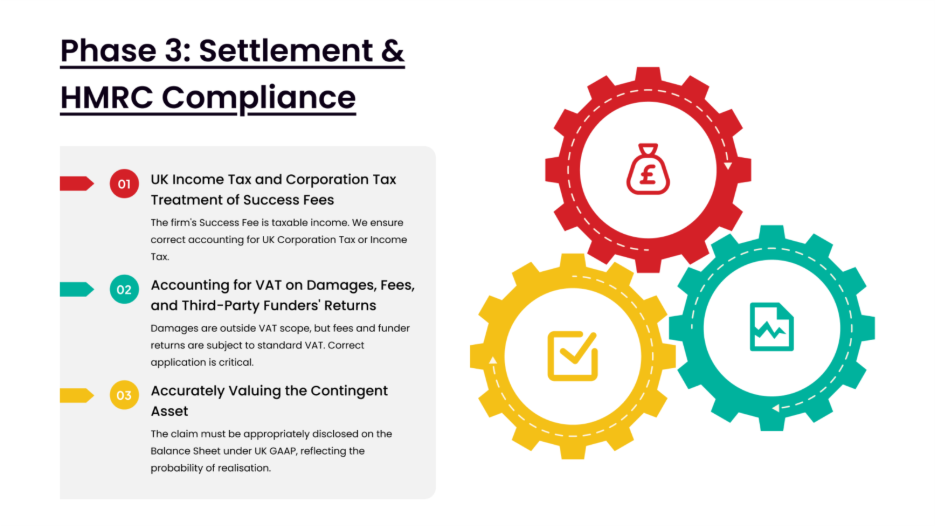
Accurately Valuing the Contingent Asset: The claim itself is a contingent asset; its realisation depends on the court outcome. We advise on the appropriate accounting disclosure under UK GAAP, reflecting the probability and potential size of the claim without overstating the firm’s Balance Sheet.
Providing Detailed Management Information (MI) to Litigation Funders: TPLF agreements require frequent, detailed Management Information (MI) on case costs, accrued fees, and expected returns. Our reporting specialists deliver the precise, high-integrity data that satisfies funders and maintains investor confidence.
HMRC Compliance: Tax and Settlement Distribution
The distribution of settlements and success fees triggers significant HMRC liability for both the firm and the clients, requiring careful planning.
UK Income Tax and Corporation Tax Treatment of Success Fees: The Success Fee earned under a CFA or the percentage taken under a DBA constitutes taxable income for the law firm. We ensure this is correctly accounted for and subjected to UK Corporation Tax or Income Tax for partners, managing the tax burden effectively.
Accounting for VAT on Damages, Fees, and Third-Party Funders’ Returns: While damages awarded to clients are outside the scope of VAT, the firm’s professional fees and the funder’s returns are usually subject to standard VAT rules. AZL structures the settlement waterfall, ensuring the correct VAT treatment is applied at each stage, preventing retrospective HMRC claims against the firm.
The AZL Advantage: De-Risking Litigation Finance in England and Wales
Managing the finances of a large-scale class action is a specialised discipline. You need a financial partner who understands the specific legal risks (SAR, POCA) and the complex commercial models (TPLF, CFAs). AZL is that expert partner.
AZL’s Specialised Litigation and Funding Accounting Services
We deliver targeted services designed to secure your litigation investment and simplify the financial operation of your most complex cases.
Establishing Financial Models for Case Viability: We build sophisticated financial models that stress-test the case under various settlement scenarios, accurately projecting Net Fee Income and Return on Investment (ROI) for the firm.
Due Diligence on Funders’ Terms: We review TPLF contracts, ensuring the financial terms are favourable and that your firm can meet the stringent reporting demands of the litigation funder, protecting your firm’s fiscal interests.
Comprehensive Knowledge of Legal and Financial Metrics: Our deep understanding of both accountancy principles and UK legal regulation ensures a compliant and profitable outcome, providing a defensive barrier against financial risk.
Ensuring Compliance with Anti-Money Laundering (AML) Rules (POCA): When large sums of damages are distributed, AZL provides rigorous checks and controls, ensuring compliance with the Proceeds of Crime Act (POCA) and other AML regulations, shielding the firm from financial crime risk.
Take the definitive step toward securing your firm’s profitability. Connect with an AZL litigation finance expert today to build the robust financial foundation your next class action deserves.
Large-scale legal actions, managed in England and Wales as Group Litigation Orders (GLOs), present unique and immense financial challenges. These cases demand substantial upfront investment, span years, and involve intricate financial structures like...
Scaling breaks inadequate finance systems. We help you discover the critical failures during rapid expansion that may threaten the stability and profitability of your UK business. The Growth Conundrum: When Success Strains Your Systems Understanding the difference between growing and scaling is critical. Growing means increasing revenue with a proportional...
The landscape for professional services firms in the UK is shifting. Traditional equity partnership models, once the standard, increasingly face challenges related to succession, capital management, and partner inclusion. Firms that rely on these structures often find themselves struggling to attract the best talent due to high buy-in costs or...





 19 June 2026
 6 April 2026