Law firm partners often face significant pressure when finalising the annual budget. Relying on last year’s figures and adjusting them incrementally is not a strategic approach; it is a financial risk. This traditional method often embeds hidden inefficiencies, leading to budget bloats that drain resources crucial for investing in growth and talent. Zero-Based Budgeting (ZBB) demands justification for every pound spent, ensuring your 2026 financial plan is lean, strategically focused, and drives maximum profitability.
Decoding Zero-Based Budgeting (ZBB): The Fundamental Shift
Zero-Based Budgeting is a rigorous financial planning method that requires all expenditures to be justified for each new period, irrespective of whether they were approved previously. It operates on the fundamental principle that every cost center starts at zero. This represents a powerful shift from traditional accounting, moving the budgetary conversation from “What did we spend?” to “What must we achieve to meet our goals?”
The Core Principle: Starting from a ‘Zero Base’
Unlike the incremental approach, which assumes previous expenses are necessary, ZBB mandates that all activities and corresponding expenditures must be reviewed and validated based on current strategic needs and expected Return on Investment (ROI). For a UK law firm, this means re-evaluating and approving every overhead cost from practice management software licensing to associate staff recruitment from the ground up, not simply renewing it.
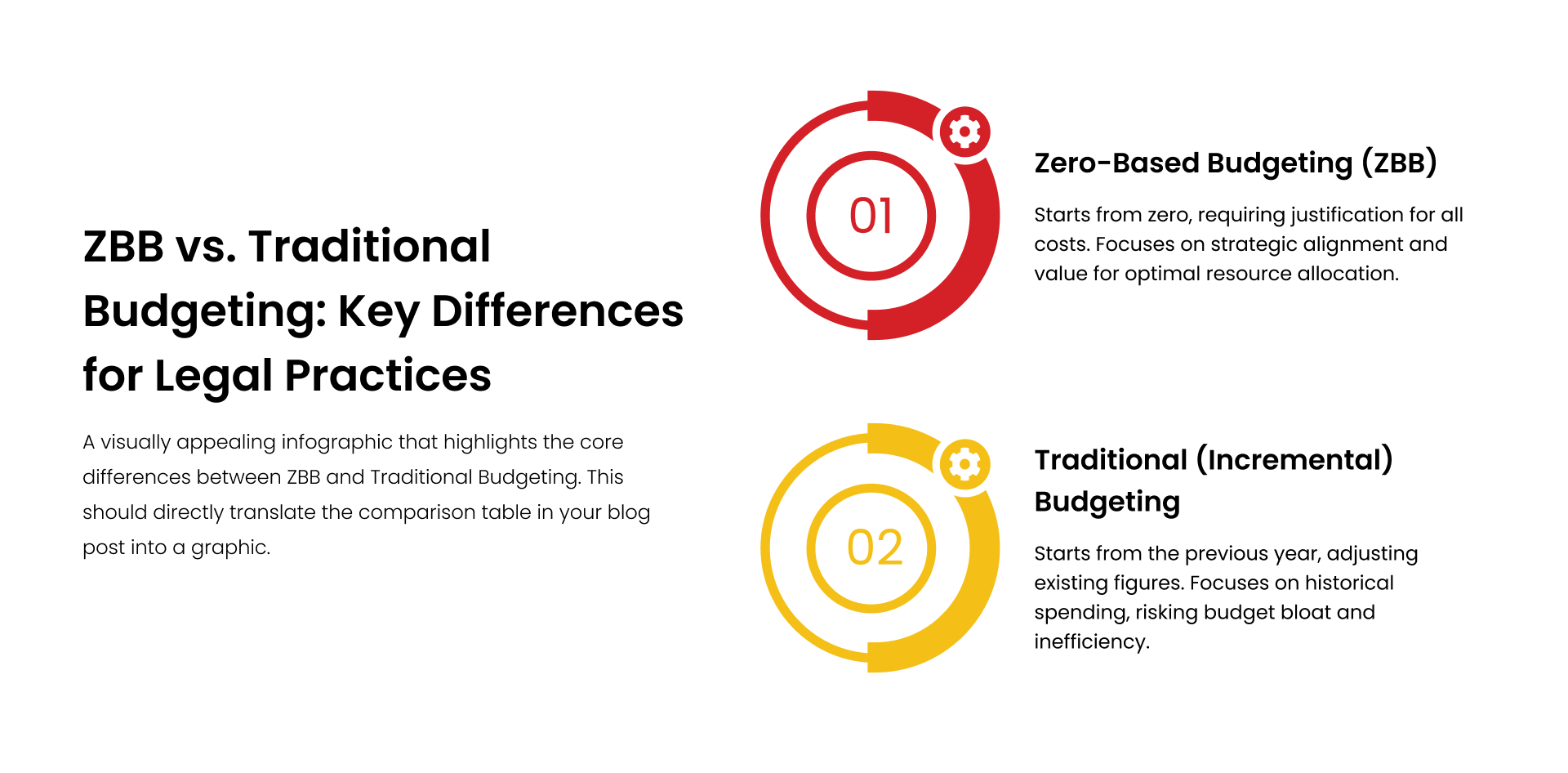
ZBB vs. Traditional Budgeting: Key Differences for Legal Practices
Law firms seeking competitive advantage must recognise the limitations of their current systems. ZBB fundamentally changes the budgetary conversation.
Feature
Zero-Based Budgeting (ZBB)
Traditional (Incremental) Budgeting
Starting Point
Zero (£0). Every cost must be justified.
Previous year’s budget, adjusted by percentage.
Primary Focus
Strategic alignment, efficiency, and value generation.
Historical spending and financial control maintenance.
Decision-Making
Justification via detailed cost-benefit analysis.
Automatic, unchallenged approval of existing costs.
Outcome
Reduced waste, optimal resource allocation, and strategic growth.
Risk of budget bloat, embedded inefficiency, misaligned spending.
Why Incremental Budgeting Fails Modern Law Firms?
This approach fails to align resources with forward-looking strategic goals, causing firms to miss opportunities for innovation and competitive advantage. It often masks inefficiencies and discourages departmental accountability for actual performance against market realities. Consequently, it embeds a harmful reliance on historical spend, creating a system where spending the full allocation becomes the unspoken goal rather than achieving cost-effective outcomes.
The ‘Use-It-or-Lose-It’ Trap and Budget Bloat
Traditional budgeting causes preserve incentives usually, and departmental heads are afraid to minimize the allocation for 2025. It can be their psychologically driven approach to spend the full budget before year end on unnecessary items. This approach, also known as ‘Use-it-or-Lose-it’ trap as this endemic behaviour is a major reason for budget bloat that diverts the important cash flow away from the real growth chances and strategic savings.
In a law firm, the largest costs typically involve salaries, real estate, and technology. If these expenditures are automatically approved without scrutiny, the firm hinders its profitability. Traditional models often:
Over-invest in underperforming practice areas.
Fail to allocate sufficient capital to high-growth departments.
Encourage spending that does not correlate with value or strategic objectives.
The ZBB process helps partners move past assumptions to focus on capital where it generates the highest return.
Lack of Transparency and Accountability
In incremental budgeting, the focus is only on the variance from the previous year. This structure provides limited insight into the actual value generated by the expenditure. ZBB resolves this by forcing every manager to:
Own their budget.
Provide clear metrics proving that their requested funds directly support the firm’s strategic objectives.
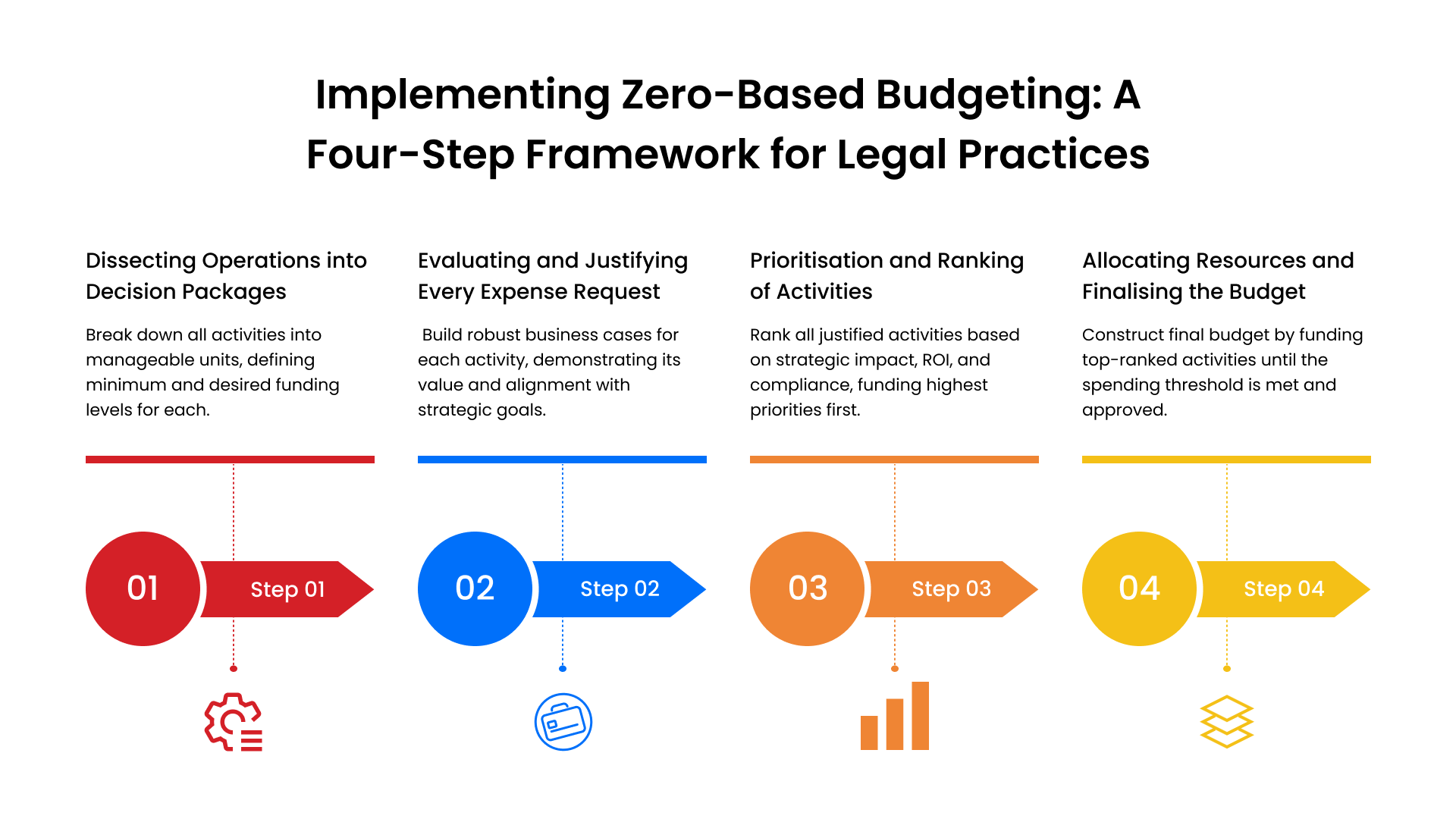
Implementing Zero-Based Budgeting: A Four-Step Framework for Legal Practices
Successfully transitioning to ZBB requires a structured, committed approach. This proven framework helps law firms systematically rebuild their financial planning from the ground up.
Step 1: Dissecting Operations into Decision Packages
The firm must dissect its entire operation into discrete, manageable units called Decision Packages. These packages detail the specific activity, the resources required, and the measurable benefits it is expected to deliver.
Categorising Costs by Essentiality
For clarity and compliance, packages must be categorised immediately:
Mandatory Costs: Essential to continue operation and regulatory compliance.
Examples:Solicitors Regulation Authority (SRA) fees, professional indemnity insurance, and non-negotiable property leases.
Discretionary Costs: Non-essential but strategic or value-adding.
Examples: Specific partner business development trips, non-mandated Continuing Professional Development (CPD), or specific digital marketing campaigns.
Defining the Minimum vs. Desired Service Level
Within each Decision Package, managers define two distinct spending levels:
Minimum Funding Level: The absolute lowest cost to maintain a critical service.
Desired Funding Level: The optimal cost to achieve maximum strategic benefit and competitive advantage.
This structured approach allows partners to make informed, granular trade-offs.
Step 2: Evaluating and Justifying Every Expense Request
Every Decision Package must pass a rigorous evaluation. The relevant Partner or Practice Manager must:
Construct a robust business case proving the activity is necessary.
Demonstrate that it delivers a quantifiable value greater than its requested cost.
Ensure clear alignment with the firm’s strategic goals for 2026.
The Practice Manager’s Role in Expense Justification
Practice Managers act as internal financial gatekeepers. They must support all requests with hard data, detailing:
The volume of work is supported.
The chargeable hours are generated.
The client retention rate or efficiency gains are influenced by expenditure.
Step 3: Prioritisation and Ranking of Activities
Once all Decision Packages are justified, the firm’s leadership guided by financial specialists must rank them.
Establish ranking criteria: Typically based on strategic impact, potential profitability (ROI), and risk reduction (e.g., SRA compliance).
Systematically rank packages from all departments.
Fund the packages with the highest priority first.
Step 4: Allocating Resources and Finalising the Budget
The firm constructs the final approved budget by systematically funding the highest-ranked Decision Packages, continuing the list until the firm’s maximum feasible spending threshold is reached. This method ensures that:
All financial resources are directed toward high-value activities.
The firm is strategically positioned for success in 2026.
The Financial and Structural Benefits of ZBB for Legal Practices
Zero-Based Budgeting is a foundational business strategy that drives long-term financial health and operational excellence within the stringent UK regulatory framework.
Enhanced Cost Control and Financial Discipline
Enforces a culture of cost consciousness across all levels of the firm.
Forces Partners and managers to be financially decisive.
Provides granular control over cash flow, resulting in a tighter, more efficient management of the Profit & Loss (P&L) statement.
Greater Accountability Across Practice Areas
Increases transparency and financial ownership across all departments.
Assigns clear cost, performance, and revenue metrics to every Decision Package.
Eliminates the ability to conceal poor performance within an inflated legacy budget.
Strategic Alignment of Spending with Business Goals
The budget becomes a perfect financial mirror of the firm’s strategic objectives.
Funds are aggressively redirected from low-value, historical spending into areas essential for growth, innovation, and enhancing client value.
Improved Cash Flow Forecasting and Working Capital Management
Detailed, item-by-item scrutiny provides superior data granularity.
This allows accountants to perform much more accurate cash flow forecasting.
Improves the firm’s working capital cycle, a critical factor given the potentially lengthy UK client billing cycle.
AZL’s Expertise in Law Firm Financial Planning
Implementing a strategic change as significant as ZBB is best achieved through specialised guidance. AZL specialises in providing bespoke financial and tax strategies designed specifically for the UK legal sector.
Tailoring ZBB to SRA Compliance and Partnership Structures
Our expert accountants ensure that your ZBB framework remains fully compliant with the demanding SRA Accounts Rules. We provide expertise in:
Law firm partners and practice managers across England and Wales face constant regulatory pressure. Managing Value Added Tax (VAT) correctly, especially regarding client fees and the accurate definition of a disbursement presents a major financial and regulatory exposure. Misclassification on an invoice...
Unidentified funds entering your legal firm’s accounts create an immediate regulatory and financial risk. In the highly regulated environment of England and Wales, where Solicitors Regulation Authority (SRA) Accounts Rules govern every transaction, a simple bank receipt with an unknown source can jeopardise your Trial Balance and compliance standing. Law firms require an...
For law firm partners and practice managers in England and Wales, managing client finances securely and compliantly presents a persistent, high-stakes challenge. The integrity of your firm hinges on impeccable financial record-keeping. You need clarity and confidence in every transaction, ensuring you satisfy the rigorous demands of the Solicitors Regulation Authority (SRA) while maintaining profitable operations. AZL Accountants provides the specialist expertise your firm needs....




 3 July 2026
 1 July 2026