Many successful law firms still face significant financial risk due to one common area of confusion: the critical difference between Costs and Disbursements. Misclassification directly compromises your firm’s VAT (Value Added Tax) recovery, distorts your true profitability, and, most crucially, risks significant breaches of the Solicitors Accounts Rules (SAR) enforced in England and Wales.
This distinction is not merely an accounting technicality; it is a fundamental compliance and solvency requirement. At AZL, our expert accountants deploy the clarity and authoritative guidance you need to classify every expense correctly, mitigate compliance risk, and secure your firm’s financial integrity.
The Foundation: Defining Costs and Disbursements for SAR Compliance
A robust financial system starts with clear, unambiguous definitions. We establish the legally accurate boundaries for these two terms, setting the critical foundation for your firm’s compliant accounting practices in the UK.
1. Defining Practice Costs: The Firm’s Internal Liability
We define Costs as the firm’s direct operating expenses, incurred for the general running of the practice. The firm is legally liable for these expenses, regardless of whether they relate to a specific client matter.
Direct Liability: The firm is the principal, the purchaser and consumer of the good or service.
Revenue Treatment: These are expenses on the firm’s Profit and Loss Statement.
Client Recharge: If these costs are passed to a client, they become part of the firm’s supply and are fully subject to standard-rate VAT.
Examples of Common Law Firm Operating Costs:
Staff salaries, PAYE, and National Insurance contributions.
Office rent, utilities, and professional insurance.
Subscriptions for legal databases (e.g., LexisNexis, Westlaw).
AZL Action: Our accountants accurately record these as internal expenses, maximizing your Input Tax claim from HMRC.
2. Defining Client Disbursements: Agency vs. Principal
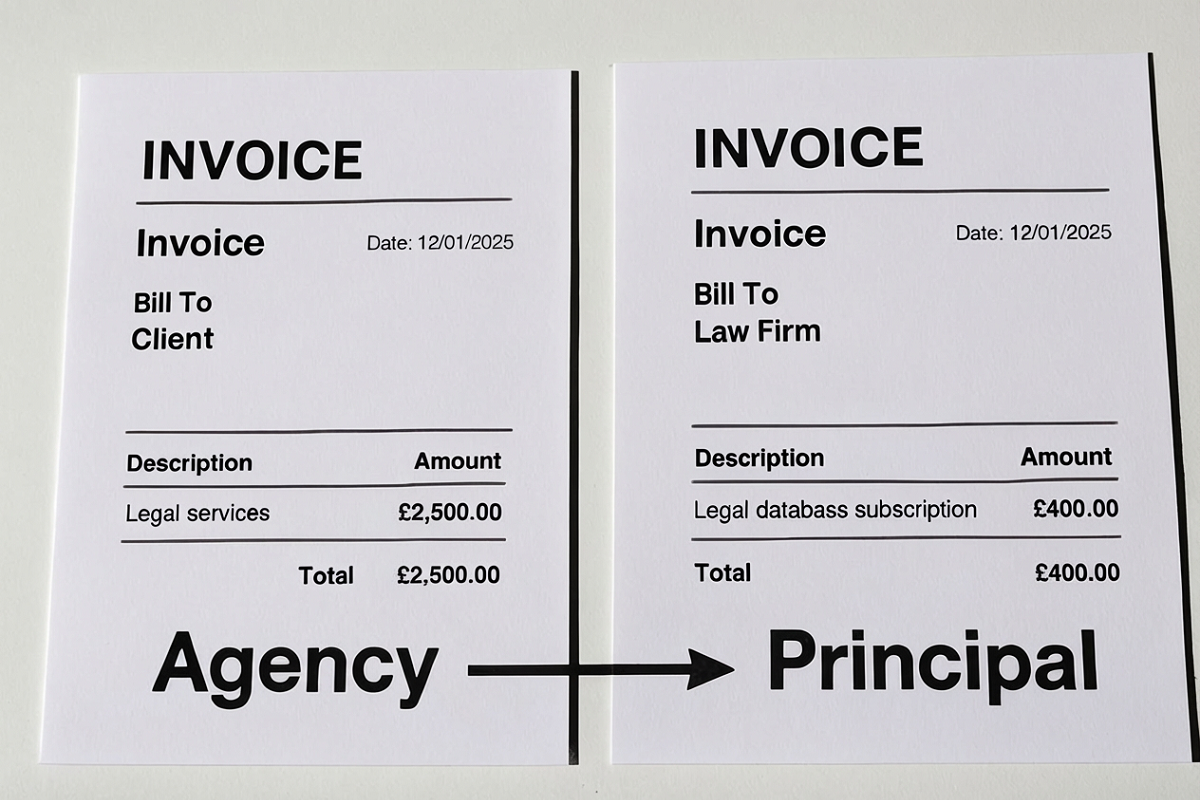
Disbursements are expenses paid by the firm strictly as an agent on behalf of, and directly chargeable to, a specific client. The ultimate liability for the expense rests solely with the client, not the firm.
The Crucial Distinction: Agency vs. Principal
The difference hinges on who the supplier’s invoice is addressed to, and who holds the legal liability for the service. Our expert guidance helps firms eliminate errors in this high-risk area.
Feature
Agency Disbursement (Outside VAT Scope)
Principal Disbursement (Rechargeable Cost, Subject to VAT)
Ultimate Liability
Rests ultimately with the Client.
Rests initially with the Firm.
VAT Treatment
Charged to the client at the supplier’s rate (often zero-rated or exempt). No firm VAT is added.
Charged to the client with standard-rate VAT added by the firm.
Typical Examples
Court fees, Land Registry fees, expert witness fees, expert reports in the client’s name.
Travel/mileage recharge, bulk photocopying, courier fees arranged by the firm in the firm’s name.
High-Stakes Compliance: VAT and SRA Risks of Misclassification
Misclassifying a Cost as a Disbursement, or the reverse, creates high-stakes problems that extend far beyond simple bookkeeping. It compromises your compliance with both the SRA and HMRC.
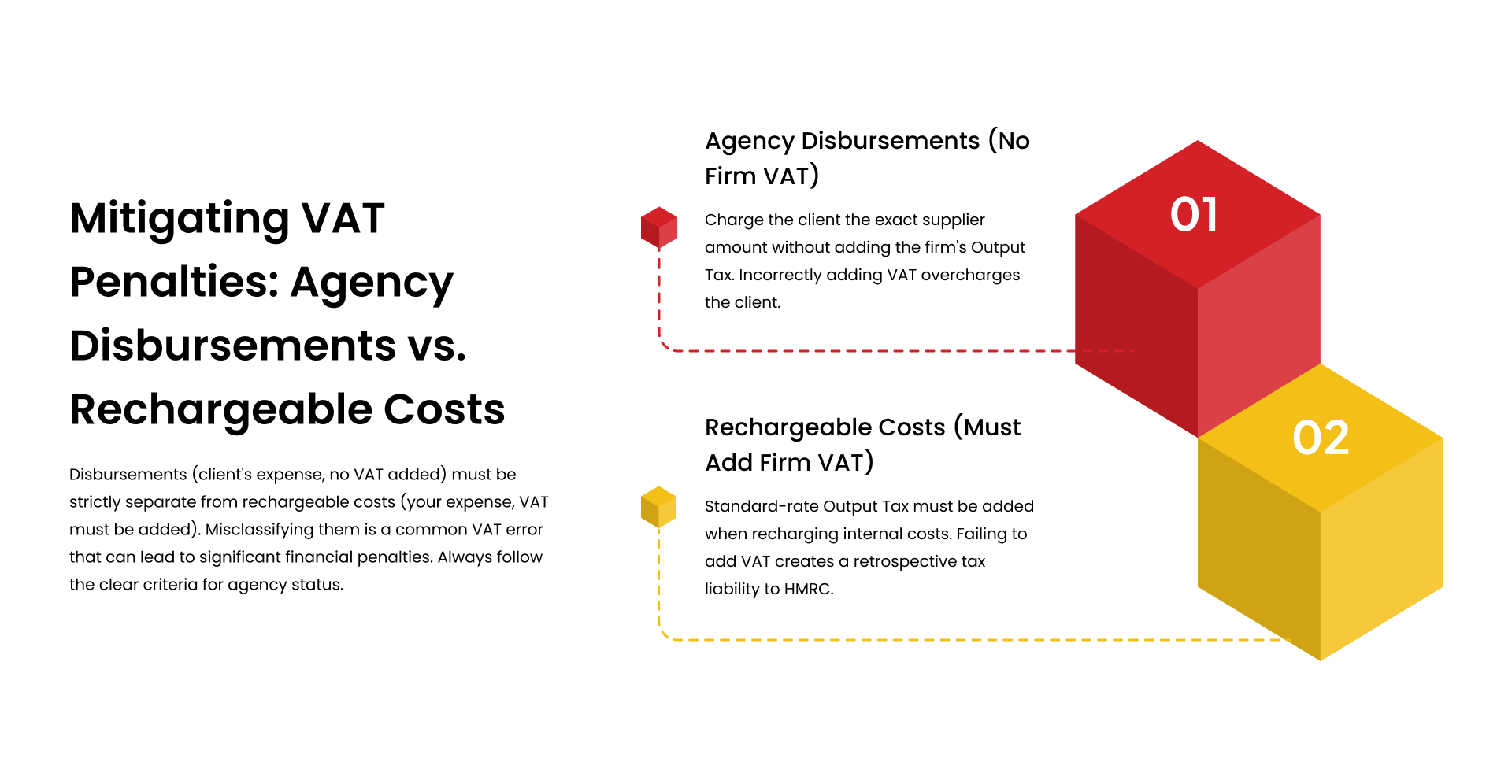
Mitigating VAT Penalties: Agency Disbursements vs. Rechargeable Costs
Incorrect VAT treatment is the most common, and potentially most costly, error in legal accounting. AZL ensures your VAT position is impeccable.
Agency Disbursements (No Firm VAT):
Action: You must charge the client the exact amount paid to the third party, without adding your firm’s Output Tax (VAT).
Risk: Incorrectly adding VAT means the firm has received income that must be paid to HMRC, resulting in a direct overcharge to the client.
Rechargeable Costs (Must Add Firm VAT):
Action: When recharging an internal cost (a supply of your firm’s resource), you must charge standard-rate Output Tax.
Risk: Failing to charge Output Tax on these recharges creates an immediate VAT liability to HMRC, which the firm must pay retrospectively, impacting cash flow significantly.
Safeguarding Client Money: Strict Compliance with the SRA Accounts Rules (SAR)
The SRA places strict duties on solicitors to protect client money. Misclassification often breaches the fundamental requirement for segregating funds.
Protecting Client Money: The Proper Use of Accounts:
The Client Account is strictly for holding Client Money—funds held on behalf of the client (e.g., an advance for future court fees).
The Office Account is for holding Office Money—the firm’s own operating funds.
SAR Breach Risk: Using the Client Account to pay a Cost (which is Office Money) or holding office money in the client account are severe SAR breaches that mandate SRA reporting.
Reimbursement Control: If you pay a Disbursement from the Office Account (a common temporary practice), the subsequent transfer from the Client Account back to the Office Account to cover that payment must be executed flawlessly and promptly.
Our AZL accountants deploy precise, compliant control mechanisms to ensure these critical client money transactions are flawlessly executed and documented.
ACT NOW: Protect Your Firm from VAT and SAR Penalties
Is your firm’s cash flow compromised by slow or incorrect reimbursement? Are you truly confident every single transaction is compliant with the Solicitors Accounts Rules?
Don’t compromise your firm’s financial health. The UK legal sector demands specialist accounting knowledge that only AZL provides.
Partner with AZL’s specialised accountants today for a robust compliance check and seamless financial management. Click here to arrange a confidential, no-obligation consultation.
Protecting Your Profitability: Accurate Reporting and Tax Deductions
Your firm’s management information is only as accurate as your underlying accounting. Misclassification distorts key metrics, leading to potentially flawed business decisions.
Accurately Assessing Gross Profit: Disbursements are not the firm’s revenue. When they are incorrectly included, your turnover is artificially inflated, skewing your Gross Profit and distorting crucial performance metrics like the Realisation Rate.
Avoiding Tax Liabilities: The firm’s tax liability (Corporation Tax or Income Tax) is based on genuine expenses. Misclassifying an expense can lead to incorrect deductions, potentially resulting in retrospective tax bills and fines from HMRC.
Case Scrutiny: Applying the Rules to Common Law Firm Expenses
We make the abstract definitions concrete by addressing common, real-world expense items that frequently confuse solicitors in England and Wales.
Expense Item
Accounting View
VAT Implication
AZL’s Guidance
Barristers’ Fees
Agency Disbursement. The firm acts as the client’s agent.
Charged to the client without adding firm VAT, regardless of the barrister’s VAT status.
Our accountants advise on correct documentation to prove the agency status to HMRC.
Client Travel/Accommodation
Principal Cost (Rechargeable). The firm usually books and takes liability for the ticket/room.
Standard-rate VAT must be added when recharged to the client (unless zero-rated transport).
We help you implement systems to correctly apply VAT to complex recharges.
Bulk Photocopying
Principal Cost (Rechargeable). This is the use of the firm’s own resources.
Standard-rate VAT must be added when recharged to the client.
We ensure your billing software automatically flags these recharges for VAT inclusion.
Best Practices for Billing and Invoicing Clients
Clear client communication and a structured invoice are your best defence against compliance risks and client disputes.
Transparency in Client Care Letters: SRA guidance requires you to clearly outline in your initial Client Care Letter how Disbursements will be handled, including the need for an advance (paid into the Client Account).
Structuring Invoices for Clarity: To ensure compliance, invoices must clearly itemise charges into distinct sections:
Professional Fees (Your Revenue, subject to VAT).
Costs/Recharges (Firm expenses passed on, subject to VAT).
Disbursements (Client expenses, often outside VAT scope).
Partner with AZL: Deploying Specialist Legal Sector Accounting
We are more than just accountants; we are specialist financial strategists for the UK legal sector. Our expertise eliminates the risks associated with Costs and Disbursements, allowing you to focus purely on delivering exceptional legal services.
AZL’s Specialised Accounting Services for Solicitors
Our services simplify the most complex compliance areas inherent to UK legal practice, transforming your firm’s financial efficiency in England and Wales.
Implementing Compliant Chart of Accounts: We design and implement structures that include specific nominal codes to correctly segregate Disbursements from Costs, ensuring accurate reporting from the moment of payment.
Proactive SAR Guidance and Audit Readiness: We provide continuous, proactive guidance on the Solicitors Accounts Rules, ensuring your firm is audit-ready at all times, reducing stress and eliminating the risk of SRA sanctions.
Rigorous Internal Controls: We establish rigorous internal controls and training to ensure absolute clarity on Client Money versus Office Money, safeguarding your SAR compliance obligations.
Next Steps for Financial Optimisation
AZL transforms accounting compliance from a source of stress into a competitive advantage. Stop risking tax penalties and SRA investigations.
Take the next definitive step toward a more secure and profitable practice. Connect with an AZL accountant today to schedule a confidential discussion and secure your firm’s compliance and financial efficiency in England and Wales.
Law firm partners and practice managers across England and Wales face constant regulatory pressure. Managing Value Added Tax (VAT) correctly, especially regarding client fees and the accurate definition of a disbursement presents a major financial and regulatory exposure. Misclassification on an invoice...
Unidentified funds entering your legal firm’s accounts create an immediate regulatory and financial risk. In the highly regulated environment of England and Wales, where Solicitors Regulation Authority (SRA) Accounts Rules govern every transaction, a simple bank receipt with an unknown source can jeopardise your Trial Balance and compliance standing. Law firms require an...
For law firm partners and practice managers in England and Wales, managing client finances securely and compliantly presents a persistent, high-stakes challenge. The integrity of your firm hinges on impeccable financial record-keeping. You need clarity and confidence in every transaction, ensuring you satisfy the rigorous demands of the Solicitors Regulation Authority (SRA) while maintaining profitable operations. AZL Accountants provides the specialist expertise your firm needs....




 3 July 2026
 1 July 2026