Law firms are increasingly leveraging flexible freelance talent from specialist consultants to senior paralegals to manage fluctuating client demand. While this gig economy model offers invaluable scalability, engaging these workers carries a substantial, firm-level tax risk: the Off-Payroll Working (IR35) legislation.
If your firm is classified as medium or large, an incorrect classification means you assume liability for unpaid PAYE and National Insurance Contributions (NICs), potentially resulting in significant backdated penalties from HMRC. Your firm requires absolute clarity and an ironclad process.
AZL Accountants provides the specialist financial and tax expertise required to secure your compliance. We ensure you benefit from flexible talent without tax exposure, transforming uncertainty into operational certainty.
Fortifying Your Defence: The Core of IR35 Compliance
IR35 is the legislation that governs whether a contractor, typically operating through a Personal Service Company (PSC), is genuinely self-employed for tax purposes or is a “disguised employee.” Mastering this distinction is fundamental to avoiding severe financial liabilities.
The Foundation: Preventing Disguised Employment
The Core Concept: HMRC created IR35 to prevent individuals who work in a manner similar to an employee from paying tax as a business, thereby avoiding the full scope of PAYE and NICs.
The Scope: IR35 applies when your firm contracts a worker who provides services through their own limited company (the PSC). The law assesses the reality of the work delivered, not merely the contract’s title.
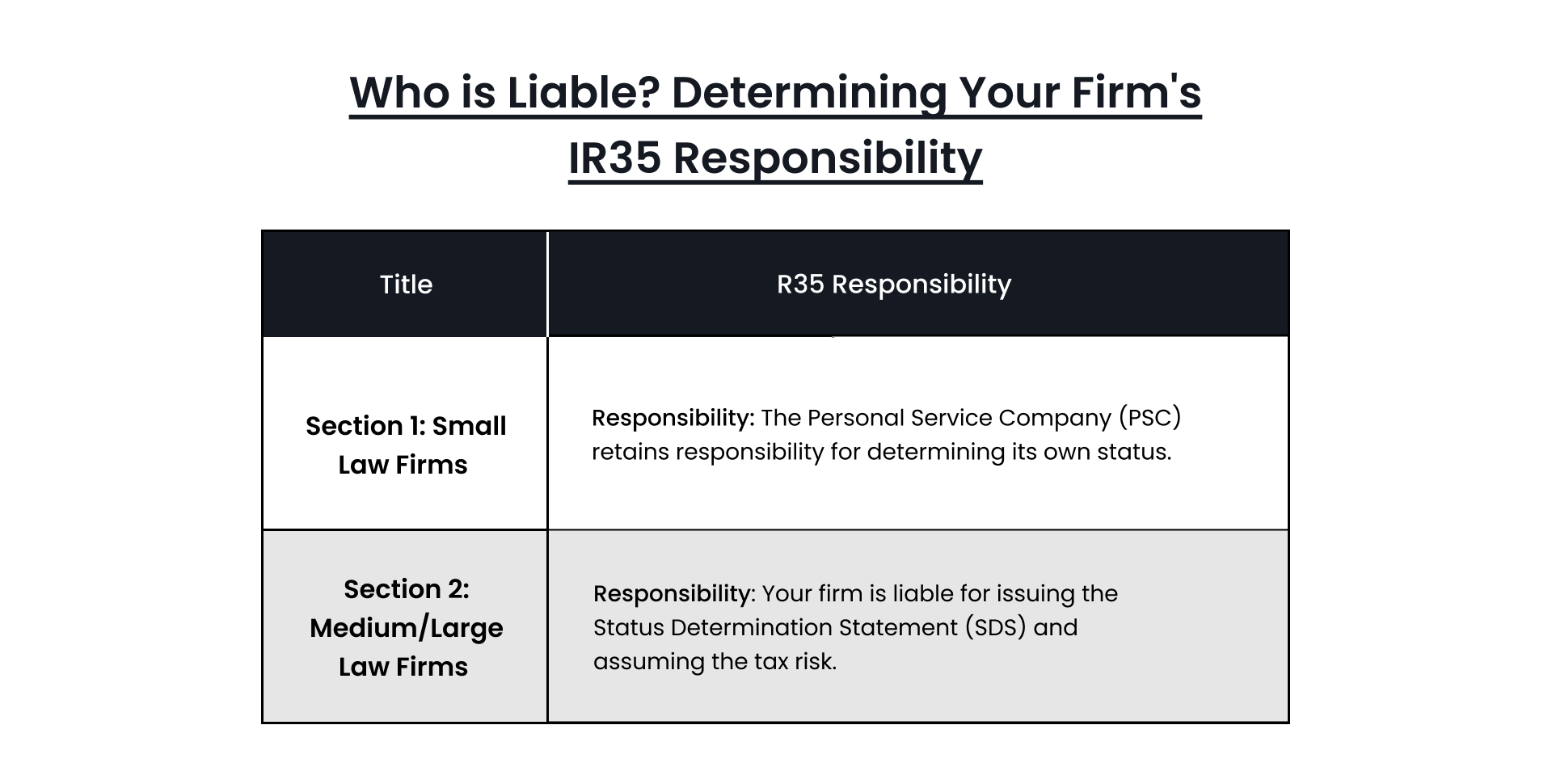
Who is Liable? Determining Your Firm’s IR35 Responsibility
The entity responsible for determining employment status and subsequently deducting tax varies based on the size of the end client. AZL Accountants helps you confirm your size status and fulfill the resulting obligations.
Rules for Small Companies vs. Medium/Large Law Firms
Liability shifts entirely based on your firm’s size:
Firm Size
Criteria (Must Meet ≥ 2 Conditions for 2 Yrs)
IR35 Responsibility
Small Firms
Turnover £15 AND Balance Sheet £7.5 AND Employees ≥ 50
The PSC retains determination responsibility.
Medium/Large Firms
Exceeds any two Small Firm thresholds
Your firm must determine the status, issue the SDS, and assumes liability for incorrect determination.
Defining the Fee-Payer Obligation
The Fee-Payer is the entity responsible for deducting the correct PAYE and NICs if the role is Inside IR35.
Direct Engagement: If you contract directly with the PSC, your firm is the Fee-Payer.
Agency Engagement: If an agency is involved, they are typically the Fee-Payer. However, your firm remains liable if you fail to exercise Reasonable Care when issuing the Status Determination Statement (SDS).
Case Law Precedents: Navigating the Three Pillars of Status
HMRC uses a long history of case law (such as the definitive Ready Mixed Concrete case) to assess status. A single factor is rarely conclusive; HMRC considers the overall picture that emerges from the facts.
1. Control: Who Dictates the Work?
The degree to which your firm controls the how, when, and where of the work strongly points towards employment.
Outside IR35 (Self-Employment)
Inside IR35 (Employment)
Autonomy over how work is done (e.g., method and sequence).
Required to work set hours or follow a fixed schedule.
Working from own location/on own equipment.
Subject to the firm’s disciplinary or performance management process.
Deciding when the work is completed, subject only to a deadline.
Supervision or direction from a line manager.
2. Substitution and Personal Service
A genuine contractor operates as a business, meaning they can typically delegate the work to maintain service continuity.
The Right of Substitution: A strong indicator of Outside IR35 is a genuine contractual right to send a substitute who is capable of doing the work.
Commercial Reality: The right must be exercised if the contractor is unable to work (Lime IT Ltd v Justin), and the substitute must not be subject to an unreasonable veto.
Mutuality of Obligation (MOO) Explained
MOO exists if your firm has an obligation to offer work, and the consultant has an obligation to accept it, a fundamental hallmark of employment. True contracts for services should be project-based with no expectation of ongoing engagement.
3. Financial Risk and Business Autonomy
A true business owner accepts the financial risks and rewards inherent in running a business.
In Business on Their Own Account: The consultant must demonstrate they are a business through tangible factors: their own insurance, multiple clients, advertising, and bearing the cost of rectifying poor work at their own expense.
Avoiding a Deemed Salary: Payment structures should align with project completion, not fixed weekly or monthly amounts that mimic a consistent salary. We help structure contracts to align payment with commercial milestones.
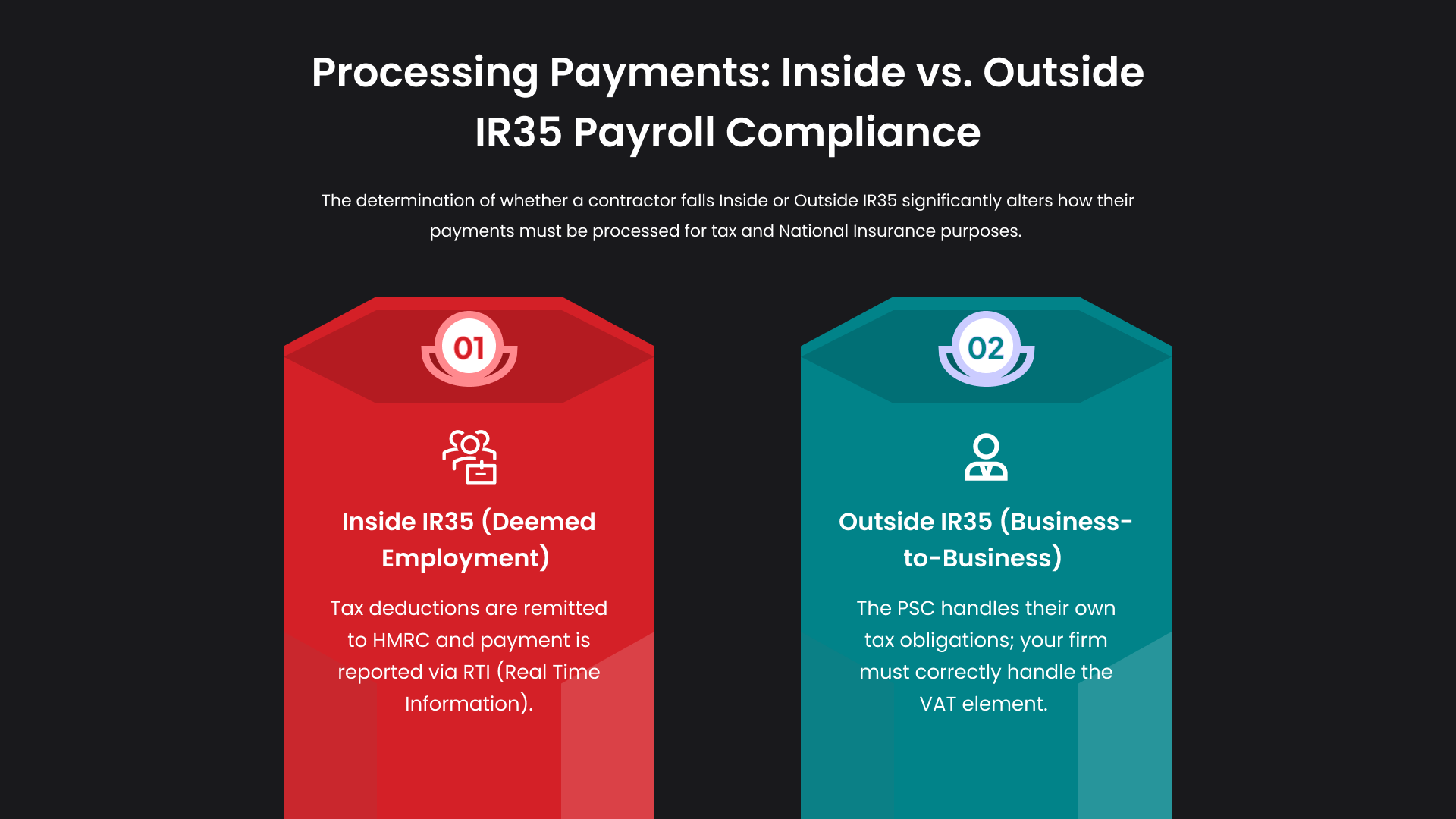
Processing Payments: Inside vs. Outside IR35 Payroll Compliance
Issuing the Status Determination Statement (SDS) is the only step. Your finance team must implement one of two distinct, legally separate payment processes. This binary choice, Deemed Employment versus Business-to-Business dictates all subsequent PAYE, NICs, and VAT obligations, demanding precision from the Fee-Payer.
The Inside IR35 Scenario: Deemed Employment
When a worker is determined Inside IR35, the Fee-Payer must process the payment as Deemed Employment income for tax purposes.
Calculate the Deemed Salary: Deduct any allowable PSC expenses first.
Apply Deductions: Apply PAYE Income Tax and employee/employer NICs to the Deemed Salary.
Remittance: The PSC receives the net payment, and the deductions are remitted to HMRC.
RTI Reporting: This payment must be accurately reported to HMRC via the Real Time Information (RTI) system on or before the payment date, just like a standard employee salary.
The Outside IR35 Scenario: Business-to-Business
If the worker is determining Outside IR35, your firm treats the relationship as a standard business-to-business transaction.
Payment Process: You pay the consultant’s PSC (limited company) the gross fee upon receiving a valid invoice.
Documentation: You must maintain clear documentation that the payment was made to the company, not the individual.
VAT: If the PSC is VAT-registered, they charge you VAT. Your firm can typically reclaim this as input tax. We ensure your accounting correctly handles the VAT element, preventing errors in your firm’s VAT returns.
The Cost of Error: Mitigating HMRC Penalties
HMRC scrutinises IR35 compliance extremely seriously. Failure to demonstrate Reasonable Care in determining status triggers severe financial risk for the Fee-Payer.
Consequences of Non-Compliance:
Backdated Liability: Your firm is liable for all the unpaid PAYE and NICs plus interest, potentially dating back six years.
Penalties: HMRC imposes significant financial penalties on top of the backdated tax.
Reputational Damage: Adverse publicity and regulatory scrutiny impact client confidence and talent retention.
AZL Accountants: Securing Your Flexible Talent Strategy
AZL Accountants acts as your specialist IR35 assurance partner, integrating legal compliance with seamless accounting practice. We secure the benefits of flexible talent while eliminating tax risk.
Specialist Support in Status Determination
We minimise your firm’s liability by establishing robust and defensible classification processes that withstand HMRC scrutiny.
Conducting Defensible SDS: We work with you to conduct detailed status assessments based on current case law, issuing a clear, auditable SDS for every engagement.
Contract Review and Practices Audit: Our service reviews the formal written contract and audits the actual Working Practices (day-to-day reality) to ensure alignment. We proactively identify and close the gaps that HMRC targets.
Comprehensive Payroll and Tax Assurance
We take the burden of complex Fee-Payer calculations off your management team, providing unparalleled peace of mind.
Managing Fee-Payer Responsibilities: We seamlessly integrate the Deemed Employment payroll processing into your firm’s structure, securing the timely and accurate deduction and remittance of all PAYE and NICs.
Management Accounts Integration: We ensure the unique accounting treatment of IR35 workers flows correctly into your Management Accounts, providing accurate and auditable visibility of profitability and labour costs.
By partnering with AZL Accountants, you gain the strategic advantage of:
Ensuring Talent Retention: Compliant engagements are preferred by high-value freelance consultants.
Avoiding Regulatory Scrutiny: Demonstrating proactive compliance safeguards your firm’s profitability and reputation.
Law firm partners and practice managers across England and Wales face constant regulatory pressure. Managing Value Added Tax (VAT) correctly, especially regarding client fees and the accurate definition of a disbursement presents a major financial and regulatory exposure. Misclassification on an invoice...
Unidentified funds entering your legal firm’s accounts create an immediate regulatory and financial risk. In the highly regulated environment of England and Wales, where Solicitors Regulation Authority (SRA) Accounts Rules govern every transaction, a simple bank receipt with an unknown source can jeopardise your Trial Balance and compliance standing. Law firms require an...
For law firm partners and practice managers in England and Wales, managing client finances securely and compliantly presents a persistent, high-stakes challenge. The integrity of your firm hinges on impeccable financial record-keeping. You need clarity and confidence in every transaction, ensuring you satisfy the rigorous demands of the Solicitors Regulation Authority (SRA) while maintaining profitable operations. AZL Accountants provides the specialist expertise your firm needs....





 3 July 2026
 1 July 2026