The difference between successful revenue and stagnation often lies not in your product’s cost, but in your client’s perception of its value. Pricing correctly is a critical strategic and psychological discipline. Many profitable UK businesses struggle with client fee resistance because they focus solely on costs, resulting in suppressed profitability.
Our expert accountants at AZL provide the crucial solution: we merge rigorous financial modelling with proven psychological strategies like Anchoring and Framing. This ensures your prices reflect their true value and maximise profit, all while maintaining strict adherence to the UK regulatory context. Partner with AZL to transform your pricing from a necessity into a strategic asset.
Flawed Foundations: Why Traditional Pricing Undermines UK Businesses
Pricing based solely on internal costs or industry averages often leaves substantial revenue unrealised. This approach ignores market dynamics and, more critically, the customer’s psychological evaluation of value, severely limiting your profit potential. AZL’s expert accountants move beyond simplistic calculations to help you price strategically.
The Problem with Cost-Plus Pricing (Ignoring Perception)
Cost-Plus Pricing is a straightforward method where you add a fixed percentage markup to all delivery costs. While it offers a basic financial safety net, this method is fundamentally flawed for businesses aiming for market leadership and maximum profitability.
Core Limitations of Cost-Plus:
Ignores Client Willingness to Pay: It fails to capture the client’s maximum value perception, especially for high-impact or specialised services.
Weak Value Proposition: You anchor your price to its lowest possible denominator its internal expense which fails to communicate the significant, long-term impact your service delivers.
Revenue Cap: It actively prevents you from charging more, even when your service offers a unique competitive advantage or superior Return on Investment (ROI).
AZL helps firms shift away from being cost-takers to becoming price-makers, using definitive financial modelling to support higher, value-based pricing.
Overcoming the Emotional Barrier: Client Fee Resistance
Clients inherently react more strongly to the immediate financial expense than to the long-term, often intangible benefit. Our accountants understand that overcoming fee resistance is fundamentally a value communication exercise.
The Psychological Focus on Immediate Cost: Clients use the upfront price tag as a shortcut for comparison, leading to unnecessary price wars.
Resistance is strongest when the benefit (e.g., streamlined tax structuring, compliance security) is not immediately visible.
AZL’s Strategy: Shifting the Focus to Return on Investment (ROI)
AZL advises framing the price as a calculated investment that generates tangible future gains, rather than an unavoidable expense. We assist by calculating and articulating the precise ROI. For instance, we reposition a £10,000 tax advisory fee into the cost that demonstrably secures £40,000 in legitimate savings or reduces Corporation Tax liability.
The Role of Financial Strategy
Effective strategic pricing requires comprehensive, predictive financial intelligence. Our expert accountants ensure your pricing is grounded in data that justifies the final figure.
Strategic Pricing Demands AZL’s Expertise in:
Financial Forecasting: We predict how various price points will impact future cash flow and overall revenue streams.
Margin Analysis: We precisely calculate the Gross Profit Margin and Net Profit Margin achieved at different volume and price levels.
Data Validation: AZL provides this critical financial validation, ensuring psychological techniques never compromise your target profitability goals.
Cognitive Leverage: Core Psychological Principles for Optimal Pricing
We implement two of the most critical psychological concepts—Anchoring and Framing to immediately influence how clients perceive and accept your pricing structure, securing stronger client retention and higher average fees.
1. Anchoring: Setting the Initial Reference Point
Anchoring is the robust cognitive bias where individuals rely too heavily on the first piece of information offered (the “anchor”) when evaluating subsequent options. In pricing, the anchor establishes the upper bound of perceived value.
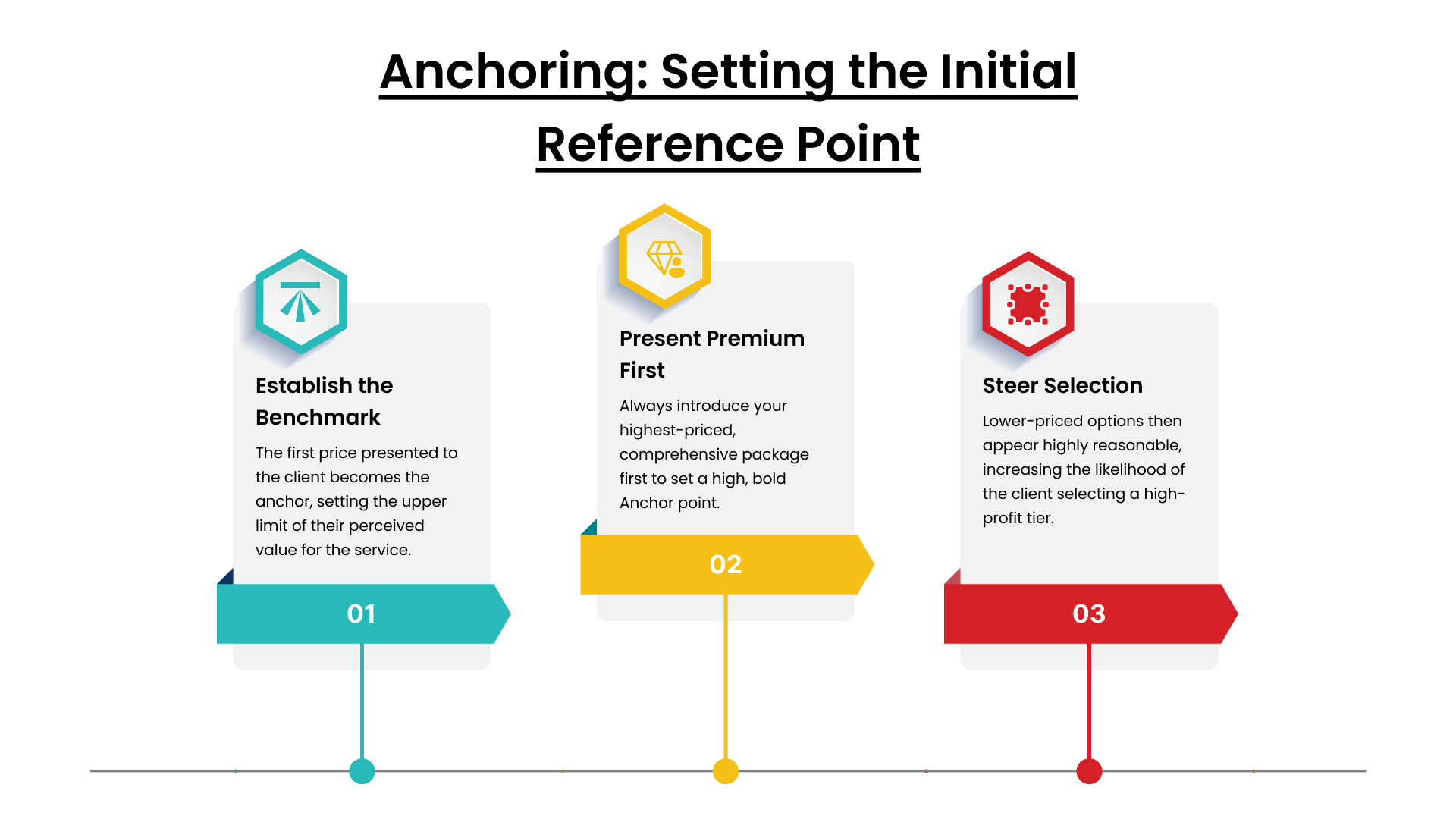
The AZL Anchoring Process:
Establish the Benchmark: The first price a client sees becomes their reference point for what is “expensive” or “acceptable.”
Present Premium First: We guide you to always introduce your premium, comprehensive package first, setting a high, bold Anchor.
Steer Selection: Any subsequent, lower-priced options then appear highly reasonable, often leading the client to select a higher-priced tier than they initially intended.
AZL’s Role: Justifying the Anchor Value
AZL’s accountants forensically calculate the true financial justification for your premium anchor price. We ensure it is defensible, aligning with the expected profitability and resource allocation. We stress that the value proposition of the anchor tier must be robustly documented, focusing on exclusivity and maximum benefit.
2. Framing and Context: Shaping Client Perception
Framing refers to how information is presented to the client, which directly affects their choice, even if the absolute monetary value remains the same.
Framing Strategy
AZL Guidance & Example Application
Psychological Impact
Daily Cost vs. Annual Fee
Repackage a £5,475 annual fee as “Just £15 a day” to have AZL’s expert managing your strategy.
Reduces cognitive weight; the price appears highly accessible and negligible.
Loss Aversion
Frame the price as preventing a loss (e.g., avoiding an HMRC audit penalty or mitigating severe tax structuring errors).
Triggers a strong motivation to avoid proven financial pain, which is a more persuasive lever than promising a future gain.
Optimising Revenue: Advanced Psychological Techniques for Conversion
AZL implements advanced, data-backed psychological techniques that, when underpinned by our financial precision, significantly enhance client conversion rates and Average Transaction Values (ATV).
The Charm Pricing Effect
Charm Pricing (using prices that end just below a round number, such as £199.99) is a powerful, subtle psychological tool.
Leftmost Digit Focus: The buyer’s mind focuses predominantly on the leftmost digit. £999 feels significantly more affordable than £1,000.
Applicability: AZL advises using this for B2B subscription services or introductory packages, subtly signalling a focus on value and affordability. We ensure the resulting numbers still make sense in the context of your margin analysis.
Price Bundling and Decoy Pricing
These techniques are highly effective for managing choice complexity and strategically steering clients toward your most profitable offering.
Decoy Pricing: Steering Client Choice
We help you introduce a third option (the Decoy) that is intentionally priced high or poorly featured compared to your target option. The Decoy makes the target option appear overwhelmingly superior in value, effectively eliminating client paralysis and increasing the selection rate of the desired package.
Strategic Packaging of Services (Bundling)
We bundle complementary services (e.g., payroll, monthly VAT preparation, and quarterly tax structuring advice) for a single price. The client perceives the bundle as a higher cumulative value than the sum of its individual parts.
AZL performs the essential margin analysis to ensure that your bundled offers remain highly profitable and tax-efficient for your specific UK operations.
UK Compliance and Financial Strategy: The Legal and Tax Viewpoint
In England and Wales, pricing strategy must be fully compliant with tax obligations, accounting standards, and consumer protection laws. AZL ensures your strategic pricing is legally and financially sound.
VAT and Pricing Transparency
VAT (Value Added Tax) rules necessitate clear and unambiguous price communication, a critical area where improper presentation can lead to significant HMRC penalties.
Ensuring VAT Compliance:
B2C Sales: For sales to the public in the UK, all displayed prices must legally include VAT.
B2B Sales: For business-to-business transactions, you may quote prices net of VAT, but this must be explicitly stated on all documentation.
AZL’s tax specialists ensure your pricing adheres to current HMRC rules and the UK Consumer Protection from Unfair Trading Regulations, which strictly prohibit misleading price displays.
Pricing Strategy and UK Competition Law
UK competition law places strict limits on competitor interactions regarding pricing, protecting fair market operations.
Avoiding Price Fixing: The UK Competition Act strictly prohibits agreements between competitors to fix prices or share markets. AZL advises clients that all pricing decisions must be made independently, based purely on internal costs and market factors.
Accounting for Tax Impacts
The optimal psychological price point must be sustainable when considering the UK’s taxation system.
Our accountants calculate the true post-tax benefit of any pricing strategy, ensuring that increased revenue translates into maximum retained earnings for your business owners, correctly factoring in Capital Allowances and eligible deductions against Corporation Tax and Income Tax.
AZL Partnership: Integrating Psychology for Sustainable Financial Health
The most effective pricing strategy is one where psychological influence meets forensic financial precision. AZL offers this unique combination to solidify your profitability and secure long-term success.
Financial Modelling for Strategic Pricing
We provide the definitive financial backbone that justifies every psychological approach you adopt. Our in-depth knowledge prevents you from underpricing or overpricing based on perception alone.
We build bespoke financial modelling systems that simulate the precise impact of price changes on your overall profitability.
We perform rigorous margin analysis on every service line to identify the pricing ‘sweet spot’ that delivers the highest sustainable Net Profit Margin.
We create compelling, data-driven financial forecasts that serve as the most persuasive tool for validating higher fees to internal partners and clients alike.
Managing payroll in-house presents a significant challenge for London businesses. It demands considerable time, resources, and a constant vigil over the ever-changing landscape of UK payroll legislation. Errors or missed...
The concept of a four-day work week holds massive appeal for law firms in England and Wales, promising improved staff morale, reduced burnout, and a competitive edge in recruitment. However, implementing this major operational shift without financial preparedness creates significant risk. Viability demands precise accounting, sophisticated revenue modelling, and strict adherence to UK employment and tax law. Your...
Large-scale legal actions, managed in England and Wales as Group Litigation Orders (GLOs), present unique and immense financial challenges. These cases demand substantial upfront investment, span years, and involve intricate financial structures like Third-Party Litigation Funding (TPLF) and Conditional Fee Agreements (CFAs). Failing to correctly structure costs, manage cash flow, and ensure Solicitors Accounts...





 24 June 2025
 27 June 2026