Litigation constitutes a significant threat to a business’s stability. When legal disputes become protracted, the sheer financial outlay generates intense pressure, often leading directors to make irrational choices. This phenomenon is the Sunk Cost Fallacy, costly human tendency to persist with a course of action simply because of prior investment.
We apply a rigorous financial framework to challenge this bias. This process helps businesses transition from an emotionally charged position to a purely financially sound choice between settlement and trial, safeguarding the balance sheet, and ensuring the company’s future.
Dissecting the Trap: Sunk vs. Marginal Costs
Sound financial judgment demands a clear-eyed view of expenditure. When faced with a settlement decision, many struggle to separate recoverable funds from those already spent. A purely rational financial decision must always look forward, evaluating the cost of continuing versus the financial benefit of concluding the dispute.
The Core Distinction: Past Costs are Irrelevant
The money already spent; the sunk cost is historical holds zero relevance to the financial prudence of any future action.
Sunk Cost: Past, unrecoverable expenditures (e.g., legal fees, internal hours paid out last year). Ignore these entirely in the current decision.
Marginal Cost: The essential future expenditure required to reach the next stage or trial (e.g., counsel fees, court payments). Analyse these as the only relevant costs.
Recognising the Fallacy’s Grip on Decision-Making
In legal cases, the Sunk Cost Fallacy manifests itself in self-justifying narratives. Leaders must identify and eliminate this emotional bias:
We must see this through to justify the £50,000 spent on disclosure.
Settling now validates the wasted time of the last three years.
We have invested too much to abandon the fight.
Leaders must psychologically separate these sunk costs from the new, marginal costs that continuation demands.
Integrating Financial Expertise with Legal Strategy
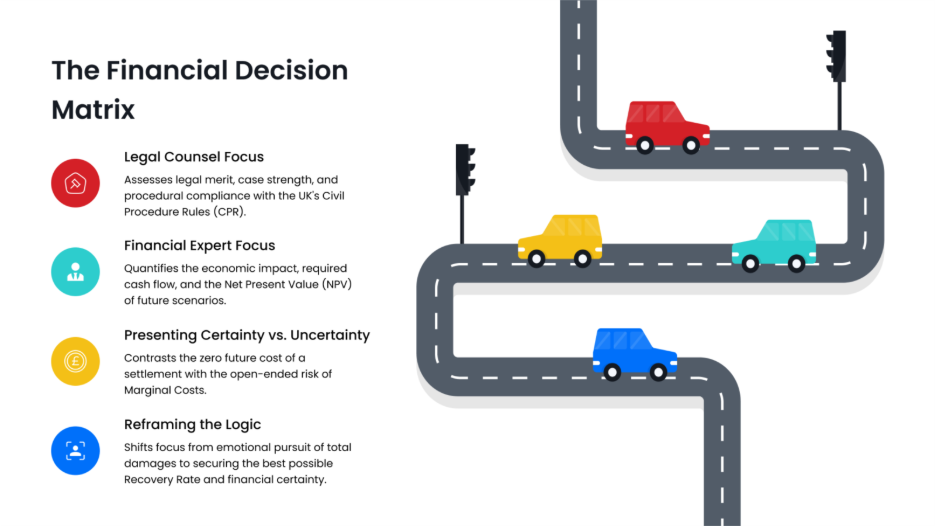
Litigation demands two distinct, yet complementary, forms of expertise. Lawyers assess legal risk, while financial experts quantify economic impact. Financial analysis provides the necessary pure cost-benefit assessment that elevates a legal opinion into a robust business decision. We use clear financial models to provide this objective layer.
Role
Primary Focus
Key Question
Legal Counsel
Case Strength, Precedent, Compliance (CPR)
Probability of winning the legal argument.
Financial Expert
Cash Flow, ROI, Net Present Value (NPV)
Quantified answer: Does the potential gain outweigh future financial costs?
Quantifying Risk: Building the Marginal Cost Framework
To make an objective decision, you must construct a formal financial model that focuses exclusively on future costs and potential future recovery. First, quantify all marginal financial commitments required to take the case to its conclusion.
Future Marginal Cost Checklist:
Counsel Fees: Barrister fees for preparation, pre-trial hearings, and trial days.
Expert Witness Fees: Costs for necessary financial, technical, or surveying experts.
Court Fees: Hearing fees, application fees, and other mandatory payments.
External Advisory Costs: Fees for litigation support or forensic accounting.
Internal Management Time: Quantified opportunity cost of director and staff time diverted from core business to case work.
Next, determine the true economic worth of a potential victory using the Expected Value (EV) calculation. This combines the maximum expected damages (D) with the legal probability of success (P).
Expected Value (Win) = D x P
The Financial Decision Rule and NPV
The Marginal Cost Framework culminates in a simple, decisive comparison:
Settle If: The estimated future marginal cost of continuing exceeds the Expected Value of a Trial Win.
Proceed Only If: The EV significantly outweighs the Cost, establishing a required Margin of Safety.
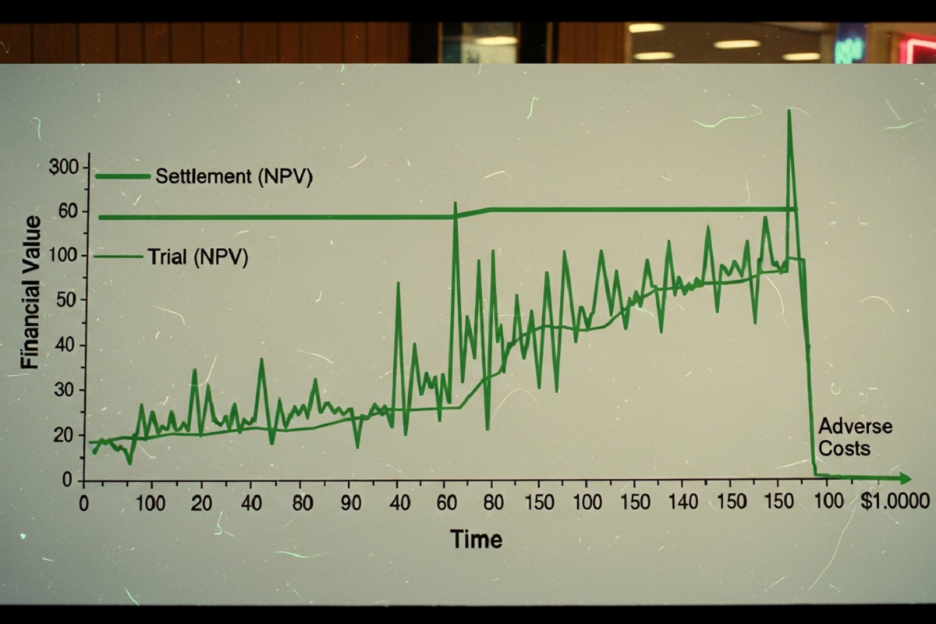
Litigation consumes capital and attention over time, which inherently devalues the potential financial outcome. Therefore, we evaluate the Net Present Value (NPV) of the dispute: a settlement offers immediate, high-value certainty, whereas a delayed, risky trial significantly discounts its future value.
Accounting for Hidden Costs: Secondary Financial Impacts
A financially sound decision acknowledges that the cost of litigation extends far beyond invoiceable legal fees. These secondary financial impacts can severely erode business profitability. Litigation consumes your business’s most valuable resource: senior management attention.
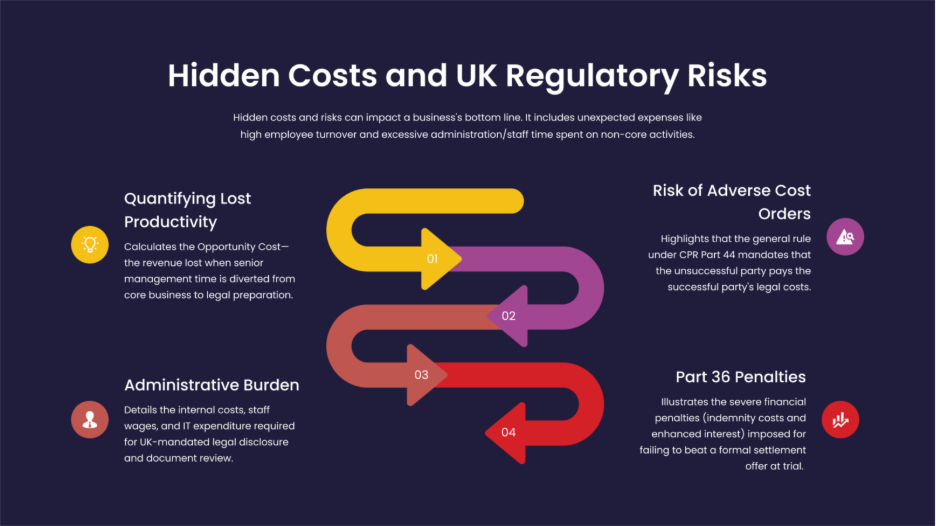
Quantifying Lost Productivity
Litigation consumes a business’s most valuable resource: senior management attention. This diversion carries a measurable cost.
Opportunity Cost Calculation: We determine the revenue or profit lost when key personnel spend time on legal preparation instead of core business development. This lost potential revenue is a critical marginal cost that continuation demands.
Administrative Burden: The process of legal disclosure under UK rules is highly resource-intensive, requiring expenditure on staff wages, IT overheads, and the potential for severe operational disruption.
Controlling Adverse Cost Risks Under UK Law
The risk of losing a case is amplified by the possibility of being ordered to pay a portion of your opponent’s costs, known as an Adverse Cost Order.
The financial framework in England and Wales is primarily governed by the Civil Procedure Rules (CPR). Under CPR Part 44, the general rule is that the unsuccessful party pays the successful party’s costs.
Failing to beat a formal Part 36 Offer at trial results in financial penalties, including paying the opponent’s costs on a punitive indemnity basis and enhanced interest.
Assess the financial superiority of the offer immediately; accept any offer that is better than the predicted NPV of continuing.
CPR Part 44 (General Costs)
General rule:Loser Pays. Forces businesses to model the risk of paying potentially hundreds of thousands in opponent’s fees.
Stress-test the budget by including the potential full amount of opponent costs in the worst-case scenario.
Misjudging a settlement under this framework significantly increases the financial risk profile of the entire litigation.
Practical Application: Driving the Settlement Decision
The final stage of the financial framework moves the analysis from calculation to communication and strategy. The purpose here is to translate complex financial modelling such as Net Present Value (NPV) comparisons and risk probability into clear, decisive advice that promotes objectivity and secures the best business decision. This requires structuring the data, so the client focuses exclusively on future risk mitigation and capital protection, rather than past spending.
Presenting the Budget: Certainty vs. Uncertainty
We use Sensitivity Analysis to model the full range of outcomes; best-case, base-case, and worst-case. This forces the client to focus on mitigating the worst possible financial loss rather than chasing the low-probability hope of a perfect victory.
Feature
Scenario A: Proceed to Trial (Uncertain)
Scenario B: Accept Settlement (Certain)
Future Cost Exposure
Marginal Costs + Adverse Cost Order Risk
Zero (Future legal fees stopped)
Financial Outcome
Expected Value (Probability-adjusted)
Guaranteed Settlement Sum
Strategic Advantage
High Risk of Catastrophic Loss
Immediate Capital Release, Focus Restored
Reframing the Logic for Decision-Makers
The analysis must shift the decision-maker’s perspective from emotional attachment to financial logic.
Emphasise Recovery Rate: Focus on the percentage of the maximum potential award you secure through settlement, before incurring further substantial costs. For example, securing £350,000 out of a £500,000 case value, and eliminating £100,000 of future marginal costs, represents excellent financial mitigation.
Prioritise Certainty: A settlement delivers the financial advantage of certainty and closure. This allows management to immediately re-focus on profit-generating core business activities, ending the loss of time and resources.
AZL’s Commitment to Financial Clarity in England and Wales
The Sunk Cost Fallacy represents one of the most critical psychological barriers to sound financial decision-making in business. Overcoming it requires objective, data-driven analysis, and the willingness to accept that past costs are irrelevant to future profitability.
AZL is a respected accounting firm committed to operating exclusively under the rigorous financial and legal regulatory standards of England and Wales. Our expert accountants provide decisive, empathetic, and professional financial counsel, ensuring every litigation strategy is factually grounded and aligned with the latest UK guidance. We deliver the clarity you need to move past emotional investment and achieve the best financial outcome for your business.
Do not let past spending dictate your future profitability. Contact AZL Accountants today for a confidential, objective financial review of your dispute and secure your path to resolution.
Litigation constitutes a significant threat to a business's stability. When legal disputes become protracted, the sheer financial outlay generates intense pressure, often leading directors to make irrational choices. This phenomenon is the Sunk...
Human capital is the primary driver of growth and, simultaneously, the single largest expense category for professional service firms and expanding businesses across the UK. For directors, partners, and finance leaders in England and Wales, the decision to hire is fundamentally a strategic investment. However, this investment is often approached...
For far too many UK business owners, financial directors, and senior managers, the accounting system is still viewed as a purely historical record keeper, a necessary tool for filing tax returns and satisfying HMRC. This traditional, reactive view of accounting is a significant constraint on growth. Looking backward to see...




 6 December 2025
 25 November 2025