Running payroll in a law firm in England and Wales demands absolute accuracy. Every calculation from basic salary to statutory leave is governed by strict UK tax laws. Payroll errors don’t just upset staff; they lead directly to HMRC penalties, interest charges, and costly audits.
You need crystal-clear definitions and rock-solid processes. AZL Accountants created this essential glossary to transform confusing accounting jargon into actionable knowledge. We streamline your firm’s compliance, ensuring every employee is paid correctly and every deduction is reported precisely. Trust our expert accountants to safeguard your firm’s financial integrity.
1. Core Payroll: Calculating Gross Pay and Net Pay Accurately
Understanding the basic components of pay and how they are taxed is the starting point for accurate payroll processing. Errors here will cascade through your firm’s entire financial ledger.
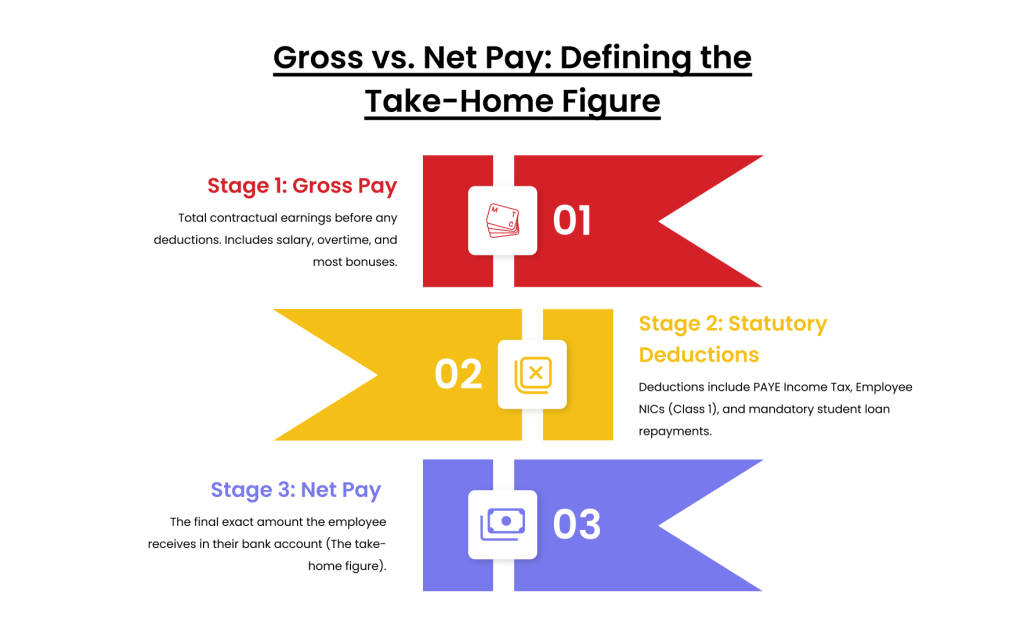
Gross vs. Net Pay: Defining the Take-Home Figure
These two terms represent the beginning and end of the pay calculation process.
Gross Pay: Total Contractual Earnings
Gross Pay represents the total amount earned by an employee before any deductions.
This figure determines Income Tax and National Insurance liability.
It includes the basic salary, overtime, commissions, and most bonuses.
Net Pay: The Final Take-Home Amount
Net Pay is the exact amount the employee receives in their bank account.
Calculation: Gross Pay minus all Statutory Deductions (PAYE Income Tax, Employee NICs, student loan repayments) and any voluntary deductions (e.g., pension, trade union fees).
Taxable vs. Exempt: Identifying Benefits in Kind (BiK)
HMRC does not treat all money or benefits provided to an employee the same way. Misclassifying these items leads to incorrect tax filings and subsequent penalties.
Identifying Benefits in Kind (BiK):
BiK refers to non-cash benefits provided by the firm (e.g., a company car, private medical insurance, subsidised gym membership).
Action: BiK is taxable and must be reported to HMRC, typically via the P11D form, as it is part of the employee’s total compensation package.
Payments Exempt from Tax (Reimbursed Expenses):
These payments cover costs incurred wholly and exclusively for business purposes (e.g., specific client travel, necessary professional subscriptions).
Compliance Rule: To remain Exempt from Tax, these must be supported by receipts, and the firm must adhere to a strict expense policy aligned with HMRC’s rules.
AZL Value:AZL Accountants verifies these claims against current HMRC guidelines to prevent unexpected tax charges and maintain compliance.
These non-negotiable tax and reporting obligations, mandated by the UK government, impact on every salary paid in England and Wales. Understanding and executing Pay As You Earn (PAYE) and National Insurance Contributions (NICs) is crucial to mitigate your firm’s exposure to severe penalties and mandatory audits from HMRC.
PAYE (Pay As You Earn): The Income Tax Mechanism
PAYE is the core mechanism the UK government uses to collect Income Tax and National Insurance from employment income at the time it is paid.
The Deduction: PAYE is Income Tax deducted at source from the employee’s Gross Pay. Your firm must calculate this deduction based on the employee’s tax code and submit it to HMRC monthly.
The Tax Code: A Tax Code (e.g., the standard 1257L) dictates how much tax-free personal allowance an employee receives (£12,570 in 2024/25). AZL ensures the correct code is used to prevent over- or under-taxation, minimising payroll queries from your staff.
National Insurance Contributions (NICs)
NICs fund state benefits, including the State Pension and NHS. Both employees and employers contribute.
Contribution Type
Paid By
Calculation Basis
Key Detail
Employee NICs (Class 1)
Employee
Deducted from Gross Salary
Contributes toward the individual’s eligibility for state benefits.
Employer NICs (Secondary)
Your Firm
Paid on employee earnings above a secondary threshold
Law firms may qualify for the Employment Allowance (up to £5,000 for 2024/25), which AZL can help you claim.
Real-Time Information (RTI) and Annual Reporting Requirements
HMRC demands real-time, accurate reporting of payroll information.
Real Time Information (RTI) Reporting:
Mandate: Your firm must report payments to HMRC using a Full Payment Submission (FPS)on or before the employee’s actual payment date.
Risk: Late or inaccurate RTI Reporting triggers penalties. Our expert team helps you eliminate this risk.
Annual Filings:
P60: A summary issued to every employee at the end of the tax year (5th April), detailing their total pay, tax deducted, and NICs paid for that year.
P11D: Used to report the monetary value of Benefits in Kind (BiK) that were not taxed through payroll.
Avoid up to 100% penalties on unpaid tax. Is your Real Time Information (RTI) submission flawless every month? Contact AZL Accountants today for a full, expert Payroll Health Check to secure compliance.
3. Statutory Leave and Pension Auto-Enrolment Compliance
Compliance in this area involves dual legal risk: correctly calculating Statutory Sick Pay (SSP) and Parental Pay reclaimable from HMRC and meeting the continuous obligations of Pension Auto-Enrolment. Failure to manage these duties precisely attracts mandatory fines from The Pensions Regulator and can severely impact your firm’s cash flow.
Statutory Payments
Your firm is legally obliged to provide minimum payments for specific leave periods.
Statutory Sick Pay (SSP) and Eligibility: SSP is the minimum amount a qualifying employee is entitled to if they are off sick for four or more consecutive days. Payroll must accurately track the qualifying days in line with employment law.
Statutory Maternity/Paternity Pay (SMP/SPP):
These payments provide financial support during parental leave.
Cash Flow Benefit: Your firm pays this amount but can reclaim a percentage (up to 100% plus small employers’ relief) from HMRC. AZL secures accurate accounting of these reclaimable amounts, protecting your firm’s cash flow.
Pension Auto-Enrolment Terminology
UK law requires employers to automatically enrol eligible staff into a workplace pension scheme.
Qualifying Earnings and Contributions:Qualifying Earnings is the band of earnings upon which minimum statutory contributions must be calculated. The law requires both the employee and the employer to contribute based on these earnings.
The Pensions Regulator: This body oversees compliance with Auto-Enrolment. Failure to meet deadlines or contribute correct results in mandatory fines. AZL Accountants handle auto-enrolment integration, actively minimising this regulatory risk for your law firm.
Law Firm Specifics: Partner Drawings vs. Employee Salary
The way partners and fee-earners are compensated requires careful separation in the firm’s accounts to avoid major tax discrepancies.
Compensation Type
Recipient
Tax Mechanism
Key Feature
Employee Salary
Fee-Earners, Support Staff
PAYE System
Fixed salary paid via monthly payroll.
Partner Drawings
Partners/LLP Members
Self-Assessment
Drawn from the firm’s Distributable Profits; not subject to PAYE.
AZL Action: We ensure correct segregation of these financial elements to prevent the misclassification of earnings and associated tax issues.
4. Financial Integrity: Payroll Ledgers and Audit Readiness
These internal procedures safeguard the integrity of your financial records. The Payroll Ledger must seamlessly integrate with your nominal accounts via accurate reconciliation. This creates the essential, auditable trail required to defend your firm against unexpected HMRC scrutiny and ensures compliance is always maintained.
Integrating the Payroll Ledger with Your Firm’s Nominal Accounts
The payroll ledger is the central record of all pay transactions, vital for financial accuracy and providing a clear audit trail.
Nominal Ledger Integration: Payroll totals (wages, taxes, NICs) must be accurately journaled into the Nominal Ledger (the main accounting book) to correctly impact the Profit and Loss (P&L) statement and Management Accounts.
Importance of Reconciliation:Reconciliation is the process of checking that the total amount paid out of the firm’s bank account matches the net pay and HMRC liabilities recorded in the payroll ledger. This prevents potential fraud and ensures zero discrepancies.
HMRC Audits and Mandatory Record Retention Periods
HMRC can audit your firm’s records at any time to verify compliance, making accessible documentation mandatory.
Preparing for HMRC Audits: An HMRC audit demands instant access to all RTI records, tax codes, expense receipts, and employment contracts. We prepare your documentation, so you are always audited.
Statutory Records Retention Period (UK Law): UK law requires you to keep all payroll and accounting records for a minimum of three years from the end of the tax year to which they relate. We advise on secure, compliant digital storage solutions.
By entrusting your payroll to AZL Accountants, you gain the strategic advantage of ensuring high staff morale through accurate pay, while simultaneously mitigating financial disputes and safeguarding your firm from the substantial costs of HMRC penalties.
Law firm partners and practice managers across England and Wales face constant regulatory pressure. Managing Value Added Tax (VAT) correctly, especially regarding client fees and the accurate definition of a disbursement presents a major financial and regulatory exposure. Misclassification on an invoice...
Unidentified funds entering your legal firm’s accounts create an immediate regulatory and financial risk. In the highly regulated environment of England and Wales, where Solicitors Regulation Authority (SRA) Accounts Rules govern every transaction, a simple bank receipt with an unknown source can jeopardise your Trial Balance and compliance standing. Law firms require an...
For law firm partners and practice managers in England and Wales, managing client finances securely and compliantly presents a persistent, high-stakes challenge. The integrity of your firm hinges on impeccable financial record-keeping. You need clarity and confidence in every transaction, ensuring you satisfy the rigorous demands of the Solicitors Regulation Authority (SRA) while maintaining profitable operations. AZL Accountants provides the specialist expertise your firm needs....





 3 July 2026
 1 July 2026