For professional services firms in the UK, the tension between billable work and strategic non-billable time such as Business Development (BD) and networking is a fundamental operational challenge. When this vital, non-tracked BD time is simply written off as “dead overhead,” it fundamentally distorts true profitability and prevents management from justifying future investment. Without data, investment is indefensible.
Our expert accountants at AZL provide the definitive financial methodology to accurately track, categorise, and validate your BD expenditure. We transform vague overhead into quantifiable Return on Investment (ROI). Partner with AZL to ensure every strategic hour contributes to your firm’s financial success.
The Financial Cost of Hidden BD Overhead
Poor time tracking for business development severely limits a firm’s growth potential. By treating valuable time as mere administrative waste, partners cannot make informed decisions about resource allocation and budget strategy.
Defining Non-Billable Time for Strategic Allocation
Not all hours spent away from client work are the same. AZL helps your firm establish clear financial boundaries to accurately distinguish time required for essential maintenance from time dedicated to strategic growth.
Necessary Overhead (Maintenance): Time spent on administration, mandatory compliance tasks, routine internal training, or managing the office. This is a non-discretionary baseline cost required for stability.
Strategic BD Investment (Growth): Time spent actively pitching for new work, networking, developing thought leadership, or speaking at industry events. This is a discretionary investment aimed directly at future revenue generation.
Why Misallocation Distorts Your Firm’s Profitability
Misallocating staff costs in your accounting records fundamentally misrepresents your firm’s internal performance, making management decisions impossible.
When the salary cost for a highly paid partner spending 20% of their time on BD is incorrectly grouped with general overhead, we see two critical distortions:
Inflated Administrative Costs: The administrative cost base swells unnecessarily.
Hidden Acquisition Costs: The true, high cost of acquiring new business is masked within operational expenses.
The Consequences of Unclassified BD Time:
Inefficient Budgeting: Management lacks the data to compare the ROI of one BD strategy (e.g., attending five networking events) against another (e.g., investing in a marketing consultant).
Inaccurate Cost-to-Serve: The firm cannot accurately assess the true financial cost for its core services because essential sales and marketing investments are hidden within operational costs.
Undervalued Talent: Partners cannot validate their non-billable time, hindering promotion and resource allocation discussions.
AZL’s Core Principle: Every Hour Must Be Mapped
Effective management accounting starts with accurate allocation. Every hour, whether billable, administrative, or strategic, must be mapped to a purposeful Cost Code. AZL embeds this principle into your internal controls and accounting software.
Method 1: Implementing Granular BD Cost Tracking
To convert time spent into measurable strategic investment, firms must transition BD tracking from informal notes to rigorous, auditable internal accounting controls, treating time as a crucial, accountable asset.
Setting Up a Granular Time Tracking System
A successful BD strategy requires the ability to track time with the same precision applied to client work.
AZL assists you in setting up detailed Cost Codes within your time management system for various BD activities, ensuring maximum reporting clarity:
Cost Code
Activity Focus
Financial Purpose
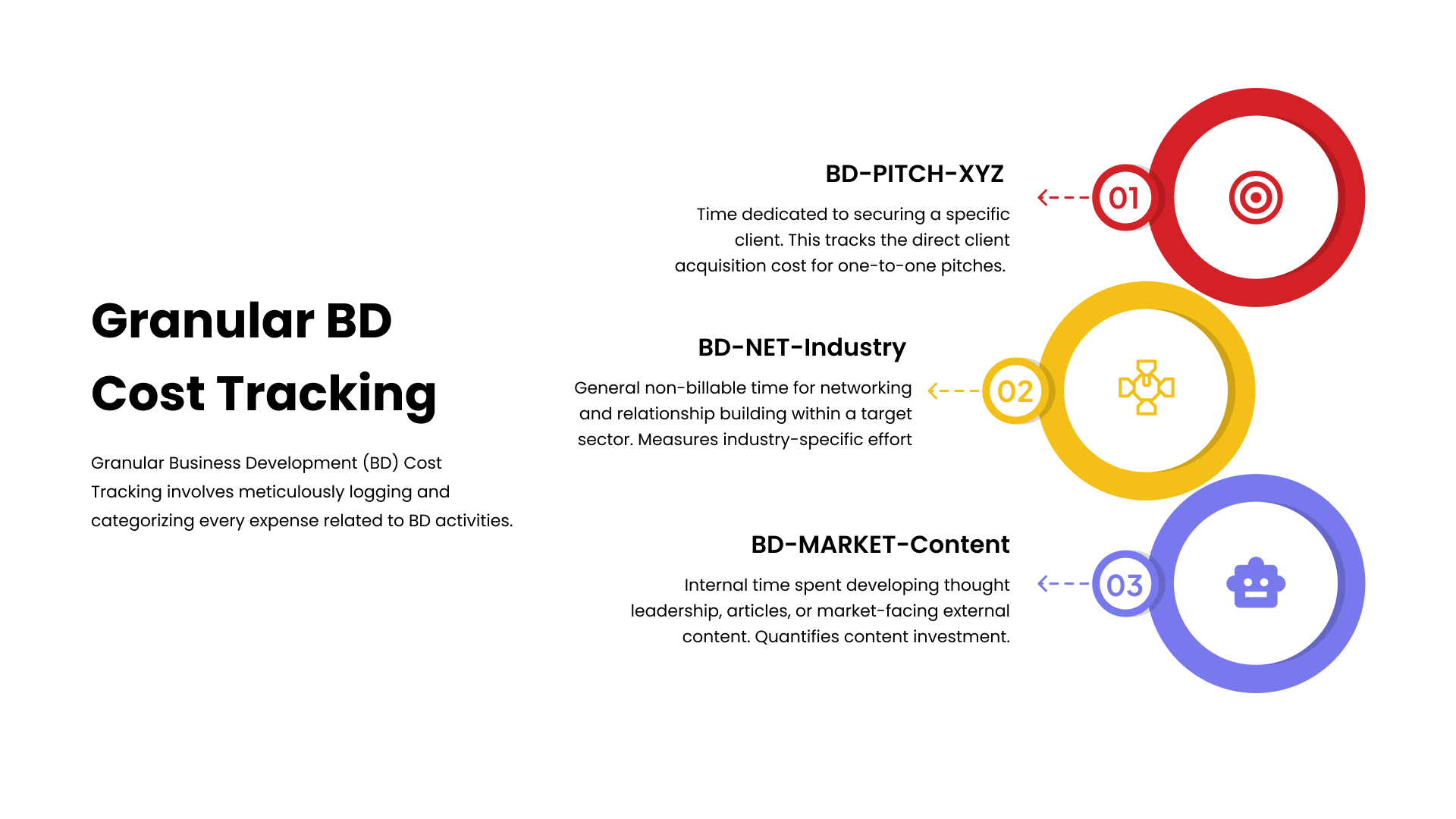
BD-PITCH-XYZ
Direct investment in securing a specific client (e.g., Client XYZ).
Track direct acquisition cost.
BD-NET-Industry
General networking and relationship building within a specific sector.
Measure industry-specific effort.
BD-MARKET-Content
Internal time spent developing thought leadership or external content.
Quantify content investment.
This granular tracking ensures the proportional cost of staff salaries is correctly allocated from the Wages account to the appropriate BD expenditure account in the Nominal Ledger, accurately reflecting the investment.
Classifying BD Time as a Strategic Period Cost
For clearer analysis and easier justification of spending, BD costs must be classified strategically on the Income Statement.
Accounting for BD Hours as Period Costs: We classify strategic BD hours as Period Costs (expenses tied to the accounting period, such as rent or advertising) rather than direct operational overhead. This clearly separates strategic investments from costs directly supporting service production.
Allocating Costs to the Correct Function: Ensuring these BD costs are allocated to the correct internal function (e.g., Sales or Marketing Expense) allows management to measure the BD function’s efficiency against its budget and pipeline value using precise financial metrics.
Method 2: Quantifying and Justifying the Return on Investment (ROI)
The critical step in validating BD expenditure is connecting the cost of non-billable time to measurable financial gains, moving beyond anecdotal success stories.
Establishing Clear Metrics for BD Success
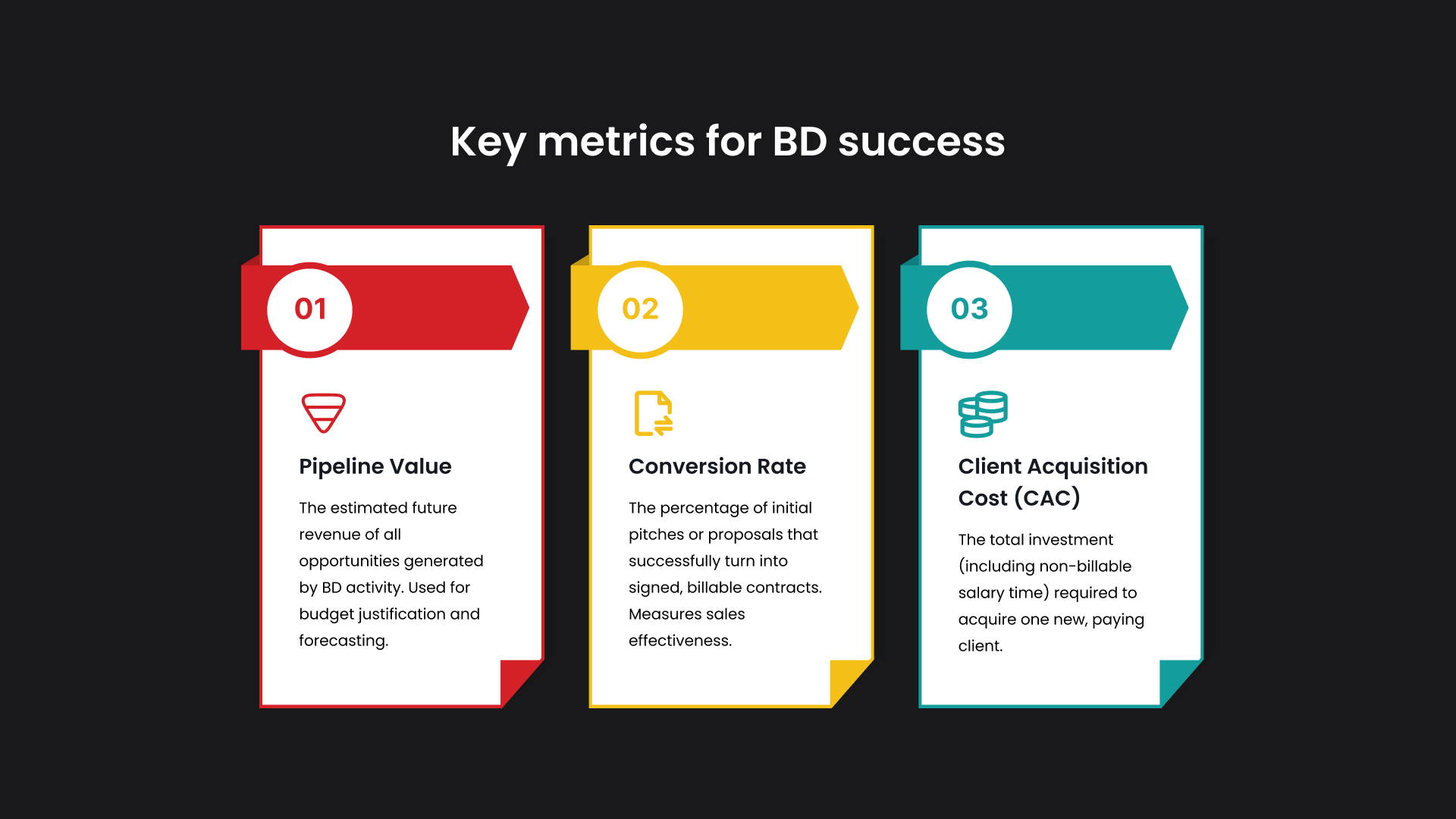
Success cannot be limited only to the final billable revenue. AZL helps professional services firms establish meaningful, intermediate metrics for evaluating BD effectiveness:
Pipeline Value: The estimated future revenue of opportunities actively generated by BD activity.
Conversion Rate: The percentage of pitches that successfully convert into signed, billable contracts.
Client Acquisition Cost (CAC): A precise calculation of the total investment (including non-billable salary time) required to acquire one new client.
Calculating and Attributing ROI
AZL helps you standardise the input variables for accurate, repeatable results that you can confidently present to stakeholders.
Rigorous Attribution Tracking: This principle involves linking specific non-billable inputs (e.g., a partner’s time spent on a critical pitch, tracked via the Cost Code) directly to the signed contract and subsequent revenue streams. This proves that the initial non-billable time was the necessary investment that directly generated the subsequent revenue.
Using Financial Forecasting to Justify Budget: AZL builds robust Financial Forecasting models that integrate historical BD ROI. This projected fee income allows you to validate future BD budgets as a necessary expense with a predictable, demonstrable return.
UK Compliance: Tax and Statutory Reporting of BD Costs
All strategic expense tracking must be rigorously grounded in UK financial and tax compliance. AZL ensures your BD expenditure is treated correctly for HMRC and Statutory reporting purposes.
HMRC Scrutiny: Deductibility of BD Expenses
HMRC applies strict rules regarding which business expenses are considered allowable expenses for Corporation Tax purposes, necessitating careful classification.
Entertainment Costs: Networking and general business entertainment costs are not allowable expenses for UK Corporation Tax purposes (with limited exceptions). We ensure client travel, staff subsistence, and certain marketing costs are correctly classified to maximise legitimate deductions while remaining compliant with HMRC rules.
Capital vs. Revenue Expenditure: We differentiate between Revenue Expenditure (day-to-day costs, immediately deductible against profit) and Capital Expenditure (long-term assets like strategic software or intellectual property, which are depreciated over time). Correct classification is essential for accurate tax structuring.
Statutory Reporting and Profit Presentation
The external presentation of BD costs must meet UK Statutory requirements, providing a True and Fair View to all stakeholders.
Presenting BD Costs Transparently: BD costs (salaries, travel, marketing spends) must be clearly presented in the Profit and Loss Account as part of administrative expenses or cost of sales, depending on the firm’s chosen accounting standard.
The Concept of Materiality: AZL advises on the concept of Materiality—ensuring that significant BD investment is clearly separated from operational costs to prevent the Financial Statements from being misstated.
Partnering with AZL for Strategic Cost Management
The transition from viewing BD as an overhead to treating it as a measurable investment requires specialist financial expertise and tailored system implementation. AZL provides this long-term strategic control.
AZL’s Specialisation in ROI Reporting
Our accountants specialize in implementing robust management accounting systems tailored for professional services firms in England and Wales. We deliver actionable insight, not just historical data.
System Implementation: We guide the establishment of compliant Cost Codes and rigorous cost allocation methods, ensuring data integrity from the time sheet to the Nominal Ledger.
Bespoke Reporting: We provide bespoke management reports that move beyond standard accounting, clearly demonstrating BD profitability, Client Acquisition Cost (CAC), and providing the justification needed to secure budget increases.
Expert Availability: Our expert accountants are on hand to clarify complex cost allocation and tax deductibility rules under UK law, ensuring maximum compliance and profitability.
Next Steps: Turning Overhead into Investable Capital
Stop tolerating unmeasured overhead. Take the definitive step toward a truly strategic financial model that proves the value of every minute spent on growth.
AZL empowers your firm with:
Integrated time tracking and financial reporting systems implementation.
Strategic budgeting and Financial Forecasting based on projected ROI.
Comprehensive review of strategic expense classification under UK tax law.
Ensure every hour generates demonstrable value. Schedule a strategic expense review with an AZL expert accountant now.
Law firm partners and practice managers across England and Wales face constant regulatory pressure. Managing Value Added Tax (VAT) correctly, especially regarding client fees and the accurate definition of a disbursement presents a major financial and regulatory exposure. Misclassification on an invoice...
Unidentified funds entering your legal firm’s accounts create an immediate regulatory and financial risk. In the highly regulated environment of England and Wales, where Solicitors Regulation Authority (SRA) Accounts Rules govern every transaction, a simple bank receipt with an unknown source can jeopardise your Trial Balance and compliance standing. Law firms require an...
For law firm partners and practice managers in England and Wales, managing client finances securely and compliantly presents a persistent, high-stakes challenge. The integrity of your firm hinges on impeccable financial record-keeping. You need clarity and confidence in every transaction, ensuring you satisfy the rigorous demands of the Solicitors Regulation Authority (SRA) while maintaining profitable operations. AZL Accountants provides the specialist expertise your firm needs....





 3 July 2026
 1 July 2026