Running a successful legal practice demands focus on complex client matters, but neglecting core financial hygiene can compromise your firm’s stability. Common bookkeeping errors from misallocating client funds to failing mandatory HMRC compliance do more than just drain resources; they invite severe scrutiny from the Solicitors Regulation Authority (SRA) and trigger fines. You need clarity and confidence in your firm’s financial reporting.
Identifying the Seven Bookkeeping Errors That Threaten Law Firm Finances
Law firms operate under a unique regulatory burden. Mistakes that might be minor in a standard business sector become critical compliance failures here, directly impacting the firm’s financial health, standing with the SRA, and tax liability with HMRC.
Mistake 1: Breaching SRA Rules by Mismanaging Client Funds
This mistake represents the most significant professional and financial risk. The fundamental principle of legal accounting is that client money must never be mixed with firm money. Failure to maintain strictly separate, segregated client accounts, even due to simple negligence, constitutes a direct breach of the SRA Accounts Rules and can lead to severe sanctions, including disciplinary action and the loss of practising certificates.
Strict Rules for Client Account Reconciliation
The SRA Accounts Rules mandate timely and accurate reconciliation of client ledgers. This is a non-negotiable requirement for protecting client funds.
You must reconcile the cash book balance with the client bank statement and the total client ledger balances.
The Rules require this reconciliation be completed at least every five weeks.
You must investigate, resolve, and document any discrepancies promptly.
Common Triggers for SRA Audits Due to Ledger Errors
The SRA monitors key indicators that flag potential breaches. Be aware of these critical triggers:
Persistent Residual Balances: Small, unresolved amounts remaining on client ledgers after a matter is concluded.
Unidentified Transactions: Funds received or paid from the client account that cannot be immediately matched to a specific client file.
Untimely Reconciliations: Failing to maintain the required five-week reconciliation schedule signals a lack of control and oversight.
Improper Transfers: Transfers made between the client and office accounts without a corresponding, compliant authorisation or bill.
Mistake 2: Failing MTD and Inaccurate VAT Reporting
Value Added Tax (VAT) for legal services involves complex rules, especially concerning how disbursements, partial exemption, and international matters are treated. Incorrect reporting or delayed submissions result in immediate financial penalties and accrued interest from HMRC.
Understanding Input and Output VAT for Legal Services
Law firms frequently err in the classification of costs, which directly impacts the VAT liability.
VAT Type
Definition
Common Error in Law Firms
Output VAT
Tax charged on fees for legal services supplied by the firm.
Incorrectly calculating VAT on fees that include disbursements, or applying the wrong rate (e.g., zero-rated property fees).
Input VAT
Tax paid on purchases for the firm’s operational needs.
The Risk of Failing to Meet Making Tax Digital (MTD) Requirements
All VAT-registered businesses, including law firms, must comply with Making Tax Digital (MTD). This is a crucial procedural compliance point:
Digital Records: You must use MTD-compatible software to keep digital records of all VAT transactions.
Digital Submission: VAT returns must be submitted directly to HMRC via the mandated digital link.
Consequence: Failure to adopt the correct digital processes results in mandatory, automatic HMRC penalties for non-compliance (Source: HMRC guidance on MTD).
Mistake 3: Misclassifying Costs and Eroding Profitability
Law firm profitability relies on accurately tracking and recovering costs. Misclassification of a cost as either a firm overhead or a recoverable client expense leads to under-billing and inaccurate profit reporting, harming the true financial picture.
Distinguishing Capital Expenditure from Revenue Expenditure for Tax Relief
For corporate and partnership tax purposes, firms must correctly allocate expenditure.
Revenue Expenditure: Day-to-day running costs (salaries, rent, stationery). Generally deducted from income to calculate taxable profit.
Capital Expenditure: Costs incurred in acquiring or improving substantial assets (new IT systems, property extension). Not immediately deductible, but relieved over time via capital allowances.
Neglecting Daily Reconciliation and Inviting Fraud
Bookkeeping is a continuous process, not a month-end chore. Leaving the critical task of reconciliation until the end of the month creates severe risk, allowing compounded errors and financial gaps to widen undetected.
The Importance of Timely Reconciliation for Fraud Detection
Daily or weekly reconciliation of both the business and client accounts is your primary defense against internal fraud, external theft, and simple transactional errors.
Control: Timely reconciliation provides true oversight of cash balances.
Risk Mitigation: Catching errors early prevents them from becoming substantial, unresolvable losses.
The Danger of Unidentified Transactions and Suspense Accounts
When transactions are not promptly matched to the correct invoice, receipt, or client ledger, they are often shunted into a Suspense Account. While legitimate for temporary holding:
Lack of Audit Trail: Allowing balances to build creates an opaque, non-compliant set of books.
Compliance Failure: Significant, long-term Suspense Account balances signal a fundamental failure of internal financial control and create serious SRA concern.
Mistake 5: Non-Compliance with HMRC Payroll (RTI & P11D)
Payroll compliance is governed by strict, real-time reporting requirements from HMRC. Law firms must ensure their obligations regarding employee pay, expenses, and benefits are managed without error.
Complying with HMRC Real Time Information (RTI) Payroll Submissions
HMRC Real Time Information (RTI) dictates that firms must report payroll information to HMRC on or before the employees are paid.
Missing these statutory deadlines, or submitting inaccurate data, results in automatic penalties.
Accurate tracking of employee data, PAYE, and tax codes is essential to meet this mandatory standard.
Managing Benefits-in-Kind (BiK) and P11D Forms
If your firm provides employees with Benefits-in-Kind (BiK) (e.g., company cars, private medical insurance), you have a reporting obligation.
You must correctly value and report these benefits on P11D Forms annually.
The statutory deadline for P11D Forms is the 6th of July following the tax year end.
Failure to file these forms or providing inaccurate valuations results in direct fines and affects both the employees’ and the firm’s tax liabilities.
Mistake 6: Weak Audit Trails for Partner Capital and Drawings
In partnership or LLP structures, the movement of money between the partners and the firm is constant but requires rigorous financial and legal documentation. Informal or poorly documented transfers create significant tax risk.
Documenting Partner Capital Contributions and Distributions
Every single Partner Capital Contribution (money put in) and Distribution or Drawing (money taken out) requires clear, supporting documentation.
Capital: Transfers affecting the partner’s capital account must be distinct from profit shares.
Drawings: Regular drawings must be correctly processed against current year profits or loan accounts.
Without a robust paper trail and correct ledger entries, HMRC can challenge the nature of the transaction.
Avoiding Discrepancies in Partnership Tax Returns
The firm’s financial accounts must maintain perfect alignment with the individual Partner’s Self-Assessment Tax Returns. Any discrepancy concerning profit share, interest paid on loans, or drawings immediately signals an issue to HMRC. This inconsistency triggers a comprehensive inquiry into the entire partnership’s financial affairs.
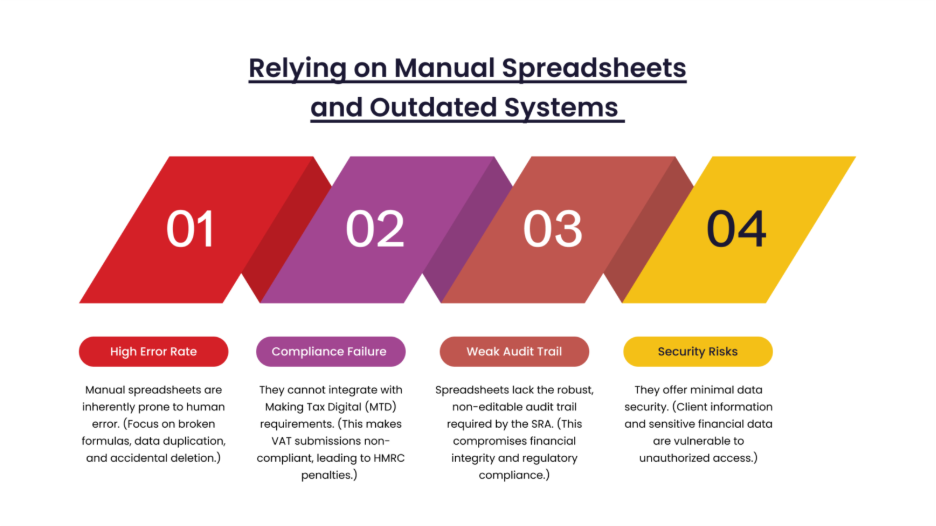
Mistake 7: Relying on Manual Spreadsheets and Outdated Systems
Relying on outdated accounting methods or vulnerable software exposes the firm to efficiency risks, severe security threats, and non-compliance with digital mandates.
Why Manual Spreadsheets Are a Liability, not a Solution
Professional legal practices cannot afford to rely on spreadsheets for core accounting:
Risk Factor
Description
Error Rate
Manual spreadsheets are inherently prone to human error, particularly broken formulas, and accidental data deletion.
Compliance
They cannot integrate with MTD requirements, making VAT submission non-compliant.
Audit Trail
Spreadsheets lack the robust, non-editable audit trail required by the SRA and HMRC.
Security
They offer minimal data security, exposing client information to unauthorised access.
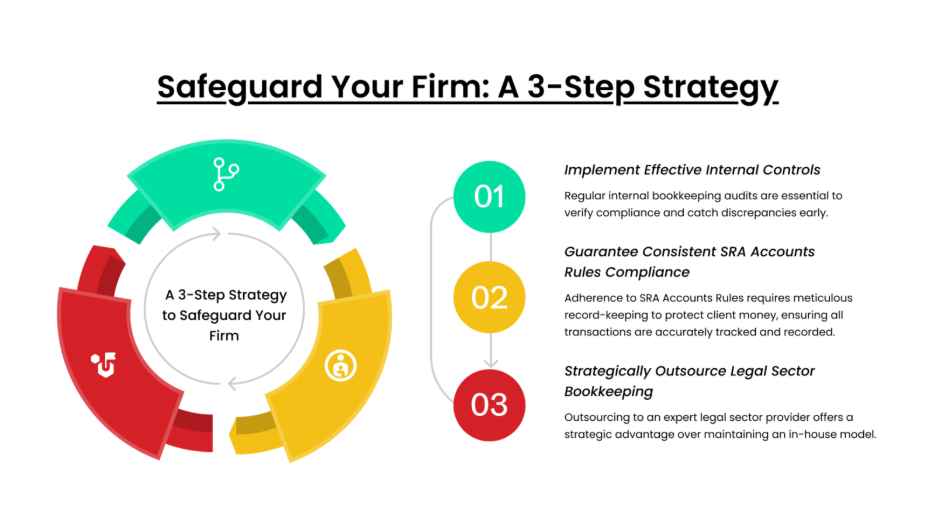
Proactive Control: A 3-Step Strategy to Safeguard Your Firm
Preventing these costly errors demands a decisive shift from reactive bookkeeping to proactive financial control. Implement these strategies now to protect your operational efficiency, profits, and professional standing.
Implement Effective Internal Controls
Robust internal controls establish systematic checks and balances within the firm, drastically reducing the opportunities for both human error and fraud.
Segregation of Duties: Minimising Risk of Error and Fraud
To uphold internal integrity, your firm must implement Segregation of Duties (SoD). This is a foundational control:
The person who authorises a financial transaction (e.g., payment of a large invoice) should not be the person who records it in the ledger.
The individual responsible for client billing should not be the one reconciling the client bank account.
This critical control minimises the risk of misappropriation and oversight errors.
The Role of Regular Internal Bookkeeping Audits
Establish a fixed schedule for rigorous internal financial audits. These checks, often performed by an external accounting firm like AZL, review core procedures:
Verification of reconciliation reports.
Review of cash handling and transfer protocols.
Assessment of full compliance with SRA client money procedures.
This proactive measure ensures problems are caught and corrected before they escalate to an SRA or HMRC inquiry.
Compliance with the SRA’s stringent requirements is a matter of professional survival. Embed these rules into your daily operations.
Key Record-Keeping Requirements for Solicitor Firms
For absolute adherence to the SRA Accounts Rules, your firm must maintain the following accessible and accurate records:
Client Ledger Accounts: Detailed records of all transactions and balances for each individual client matter.
Office and Client Cash Books: Centralised records for all client and firm money received and paid.
Bank Reconciliations: Dated, comprehensive records for both office and client bank accounts, reviewed regularly.
Transfer Records: Full audit trail documentation for every transfer of funds between the client and office accounts.
Strategically Outsource Legal Sector Bookkeeping
Partnering with an accounting firm specialising in the legal sector converts an administrative risk into a strategic asset, providing immediate access to law-firm-specific compliance expertise.
Convert Fixed Overhead Costs to Predictable Professional Expenses
Maintaining a specialised in-house bookkeeping team requires significant fixed costs (salary, dedicated software, continuous training, recruitment).
In-House Model
Outsourced AZL Model
High Fixed Salary Cost
Predictable Variable Expense
Risk of Staff Turnover/Error
Guaranteed Expert Continuity
Internal Training Burden
Immediate Access to UK Law-Specific Expertise
AZL: Specialist Compliance and Accounting for UK Law Firms
Protecting your legal practice from financial penalties and regulatory sanctions demands more than generic accounting services; it requires specialised, precise knowledge of the legal sector.
Our Commitment to Accurate HMRC and MTD Reporting
AZL ensures absolute precision in all your tax submissions.
We ensure your practice is fully compliant with HMRC’s Making Tax Digital (MTD) framework.
We handle all mandatory forms, including P11Ds, VAT returns, and partnership tax guidance forms, accurately and submit them on time.
Ensuring Complete Adherence to SRA Accounts Rules
Our expert accountants manage client money records, perform mandated reconciliations, and structure your reporting systems to satisfy the SRA Accounts Rules. We provide the audit-ready books and verifiable records that give partners peace of mind and demonstrate complete financial integrity.
Ready to eliminate compliance risk and secure your firm’s profitability?
Schedule a Confidential SRA Compliance Review with AZL today to review your current bookkeeping and implement a strategy for guaranteed financial control.
Managing payroll in-house presents a significant challenge for London businesses. It demands considerable time, resources, and a constant vigil over the ever-changing landscape of UK payroll legislation. Errors or missed...
The concept of a four-day work week holds massive appeal for law firms in England and Wales, promising improved staff morale, reduced burnout, and a competitive edge in recruitment. However, implementing this major operational shift without financial preparedness creates significant risk. Viability demands precise accounting, sophisticated revenue modelling, and strict adherence to UK employment and tax law. Your...
Large-scale legal actions, managed in England and Wales as Group Litigation Orders (GLOs), present unique and immense financial challenges. These cases demand substantial upfront investment, span years, and involve intricate financial structures like Third-Party Litigation Funding (TPLF) and Conditional Fee Agreements (CFAs). Failing to correctly structure costs, manage cash flow, and ensure Solicitors Accounts...





 24 June 2025
 27 June 2026