Merging or acquiring another practice is a pivotal moment that carries significant financial and regulatory exposure. A successful outcome requires more than constructive collaboration; it demands financial oversight and a robust, structured integration plan. Without specialist financial guidance, firms risk inheriting undisclosed liabilities or facing immediate integration failures.
This guide provides a definitive financial checklist for law firm leaders in the UK, clarifying the accountant’s critical function from initial valuation through to post-completion system alignment.
Pre-Acquisition: Validating Value and Mitigating Financial Risk
The pre-acquisition phase dictates the ultimate success and profitability of the merger. Rigorous financial due diligence acts as the primary defense against overvaluation and inheriting undisclosed liabilities. This independent scrutiny moves beyond surface-level accounts to systematically dissect the target firm’s operational economics, regulatory history, and long-term viability. A comprehensive due diligence exercise prevents post-completion shock and provides essential leverage in price negotiations.
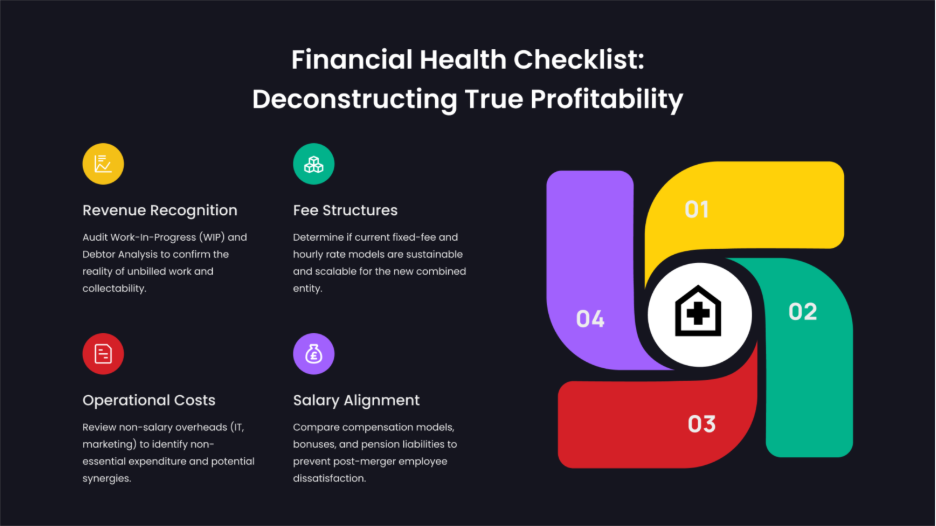
Financial Health Checklist: Deconstructing True Profitability
Due diligence must validate the target firm’s long-term stability, focusing on key metrics unique to the legal sector. The accountant scrutinises these elements to establish a factual basis for the transaction.
Area of Examination
Key Financial Focus
Importance (Why This Must Be Audited)
Revenue Recognition
Work-In-Progress (WIP) Valuation and Debtor Analysis.
Confirm the reality of unbilled work and the likelihood of collecting outstanding client debts. Inflated WIP artificially boosts profits.
Fee Structures
Assessment of fixed-fee and hourly rate
Determine if current pricing models are sustainable and scalable within the new combined structure.
Operational Costs
Review of non-salary overheads, IT costs, and marketing spend.
Identify areas of non-essential expenditure or potential cost-saving synergies post-merger.
Salary Alignment
Comparison of compensation models, bonus structures, and pension liabilities.
Prevent employee dissatisfaction post-merger due to unequal pay or unrecognised benefit liabilities.
Deep Dive into Revenue and Cost Quality
Effective due diligence requires a granular look at how revenue is generated and how efficiently costs are managed. In the legal sector, this often means focusing on the time between billing and collection, known as the lock-up period. A long lock-up period indicates poor cash flow management, which immediately impacts the acquiring firm’s working capital requirements.
Key Financial Quality Indicators to Scrutinise:
Lock-Up Period Analysis: Calculate the firm’s average days outstanding for both WIP and debtors. A high number suggests cash flow stress and requires immediate post-merger intervention.
Irrecoverable Costs: Identify and quantify costs associated with abandoned or unsuccessful cases that were previously capitalised.
Technology Debt: Assess the age and viability of the firm’s core practice management and IT systems. Underspending in this area leads to significant, unavoidable capital expenditure post-merger.
Forensic Review of Partner Drawings: Ensure that partner distributions are genuine profit shares and sustainable capital injections or disguised costs.
Specific financial and regulatory compliance in the UK must be verified rigorously before completion. Inheriting compliance breaches can lead to immediate and severe penalties from regulatory bodies like the SRA.
Solicitors Accounts Rules (SAR) Compliance:
Client Money Segregation:Review records to ensure full and proper separation of client money from office money, a non-negotiable requirement of the SRA.
Internal Controls:Confirm that the firm’s systems for handling client funds meet the SRA’s requirements for financial control.
Identifying Breaches:Quantify and disclose any historical SAR breaches, as these represent immediate, unavoidable regulatory risk.
Coverage Adequacy: Evaluate the target firm’s PII coverage in relation to its practice areas and claims history.
Contingent Liabilities: Assess any ongoing claims or circumstances that may lead to future claims, as these must be provisioned for as contingent financial liabilities.
Post-Acquisition: Streamlining Financial Integration for Value
Successfully merging two entities requires a structured, immediate focus on financial and administrative alignment. This phase is crucial for capturing promised efficiencies and realising revenue synergies. Successful Post-Merger Financial Integration demands unification and strict regulatory adherence.
Unifying Systems: Alignment and Data Migration
Achieving the expected merger synergies requires the swift and precise unification of all financial platforms and reporting protocols. This process establishes a single, cohesive finance department capable of producing accurate, unified, and compliant reports from the first day of the new entity’s operation.
Key Integration Steps:
Standardisation of Accounting Policies:Establish unified policies for capitalisation, depreciation, and expense classification.
Chart of Accounts Creation:Implement a single, consistentChart of Accounts to serve as the backbone of the merged financial records.
Data Migration Strategy:Plan the transfer of financial data (ledgers, payroll history) from the target system to the acquirer’s platform efficiently.
Meeting the MTD Mandate
The combined firm’s systems must comply with the UK’s ongoing digital tax requirements.
Integration:Integrate all accounting and financial software onto a platform that meets HMRC’s Making Tax Digital (MTD) requirements for VAT submissions.
Verification:Verify seamless digital submission capabilities for VAT returns and future compliance with MTD for Income Tax Self-Assessment (ITSA).
Mergers inherently trigger specific tax obligations that require expert structuring and precise filing to ensure efficiency and avoid unexpected liabilities. We address the tax consequences arising from the sale and the transfer of assets:
CGT Planning: Advise on the potential Capital Gains Tax (CGT) liabilities for selling partners and structure the sale accordingly.
SDLT Minimisation: Structure the acquisition to legally minimise Stamp Duty Land Tax (SDLT) exposure on the transfer of commercial property assets.
HMRC Filing: Ensure the correct and timely filing of all relevant forms with HMRC based on the chosen legal structure of the transaction.
Employee Payroll and Benefits Harmonisation
The integration of the workforce demands payroll management and alignment of benefit schemes, ensuring ongoing PAYE compliance.
Alignment:Align employee pension schemes, benefits packages, and compensation models to create a unified structure.
Compliance:Ensure immediate and accurate compliance with PAYE reporting obligations for the consolidated workforce with HMRC.
UK Compliance Mandates: Key Filings and Regulatory Audits
Financial accountability requires prompt notification and adherence to the administrative and audit requirements of the UK’s primary regulatory bodies.Companies House mandates annual filing of Statutory Accounts and a Confirmation Statement. Financial firms are regulated by the FCA and PRA. Larger entities must complete a statutory audit to ensure financial statements provide a ‘true and fair view’ under the Companies Act 2006. Non-compliance carries penalties.
The firm must take specific administrative actions to notify tax authorities of the change in legal structure and size.
HMRC Actions Checklist:
VAT Registration: Update or re-register the VAT group with HMRC to reflect the new entity.
Corporation Tax (CT):Notify HMRC of the new structure and ensure all predecessor entities file their final CT returns by the statutory deadline.
SAR Reporting and Audit Requirements
The SRA mandates a formal financial report to confirm adherence to its rules following any material change in the firm’s structure.
The newly merged firm must submit a formal Accountant’s Report under the SRA’s rules.
This report confirms continuous and post-integration adherence to the Solicitors Accounts Rules (SAR), a fundamental safeguard for client funds and the firm’s licence to operate.
Your Partner for Confident Law Firm Mergers in England and Wales
The financial success of a law firm merger is determined by accurate planning and authoritative financial guidance. Our specialist accountants at AZL deliver decisive, detailed support throughout the entire M&A lifecycle. We ensure technical accuracy and provide the confidence you need, adhering to the latest UK law, SRA guidance, and HMRC regulations. Our commitment is dedicated to supporting law firms throughout the England and Wales region, providing the expertise necessary for secure and successful integration.
Ready to de-risk your merger and accelerate integration? Secure your strategic future by scheduling a confidential consultation with AZL’s specialist accounting team today.
Law firm partners and practice managers across England and Wales face constant regulatory pressure. Managing Value Added Tax (VAT) correctly, especially regarding client fees and the accurate definition of a disbursement presents a major financial and regulatory exposure. Misclassification on an invoice...
Unidentified funds entering your legal firm’s accounts create an immediate regulatory and financial risk. In the highly regulated environment of England and Wales, where Solicitors Regulation Authority (SRA) Accounts Rules govern every transaction, a simple bank receipt with an unknown source can jeopardise your Trial Balance and compliance standing. Law firms require an...
For law firm partners and practice managers in England and Wales, managing client finances securely and compliantly presents a persistent, high-stakes challenge. The integrity of your firm hinges on impeccable financial record-keeping. You need clarity and confidence in every transaction, ensuring you satisfy the rigorous demands of the Solicitors Regulation Authority (SRA) while maintaining profitable operations. AZL Accountants provides the specialist expertise your firm needs....






 3 July 2026
 1 July 2026