The fourth quarter (Q4) marks the critical final push in the financial calendar—your last opportunity to ensure records are compliant before submitting Statutory documents to HMRC and Companies House. A rushed or incomplete year-end process immediately exposes your business to the risk of penalties, costly HMRC inquiries, and inefficient tax structuring.
Our expert accountants at AZL eliminates this uncertainty. We provide a definitive, 10-point checklist, honed through years of experience with UK legislation and accounting standards, to guarantee a clean, accurate close. Partner with AZL to secure financial peace of mind and transform compliance into a strategic asset.
Compliance and Strategy: The Imperative of a Clean Close
A year-end close is non-negotiable for all UK companies. It serves two crucial, interconnected purposes: fulfilling mandatory legal duties and securing the accurate data needed for future business growth and strategic decisions.
Why Q4 Closure is Critical for Statutory Compliance
The accuracy of your Q4 bookkeeping dictates the legality and acceptance of your required submissions to the UK authorities.
Aligning with UK Obligations: The clean close directly informs the filing of your Annual Accounts and the precise calculation of your Corporation Tax liability.
Adherence to Standards: AZL ensures your bookkeeping adheres strictly to the applicable standards (e.g., FRS 102 or FRS 105), safeguarding your firm against common technical breaches.
Avoiding Penalties: HMRC imposes substantial penalties for late filing or for filing Financial Statements that contain errors of Materiality. Companies House also imposes financial penalties for late submissions. AZL implements the checks required to mitigate these avoidable costs.
The Strategic Benefits of Timely Closure
Beyond mandatory compliance, a timely and clean closure offers significant strategic benefits for stakeholders and management, enabling smarter decision-making.
Accurate Profit and Equity Calculation: A clean close allows for the accurate calculation of retained earnings and distributable profit. This is vital for owners planning dividends or strategic reinvestment. Rushed or inaccurate figures can lead to illegal dividend payments.
Informing Financial Forecasting: The verified Q4 closing balances become the reliable opening balances for the new fiscal year, providing the essential foundation for your next year’s budget and crucial Financial Forecasting.
AZL’s Approach to Ensuring Audit Readiness
Following this definitive checklist is the foundational first step our accountants take in preparing your books for any potential scrutiny or formal audit.
We implement a systematic, documented methodology that ensures transparency and traceability for every entry. We perform internal Trial Balance reviews against a rigorous AZL standard, identifying anomalies early. Our internal process is so thorough that the books are essentially “audit-ready” before we even begin preparing the final Annual Accounts, significantly reducing final audit time and fees.
Ledger Integrity: The Essential 10-Point Year-End Checklist (1–5)
The first half of the checklist focuses on forensically reconciling core financial ledgers and ensuring all recorded assets and liabilities reflect the true financial position on the year-end date.
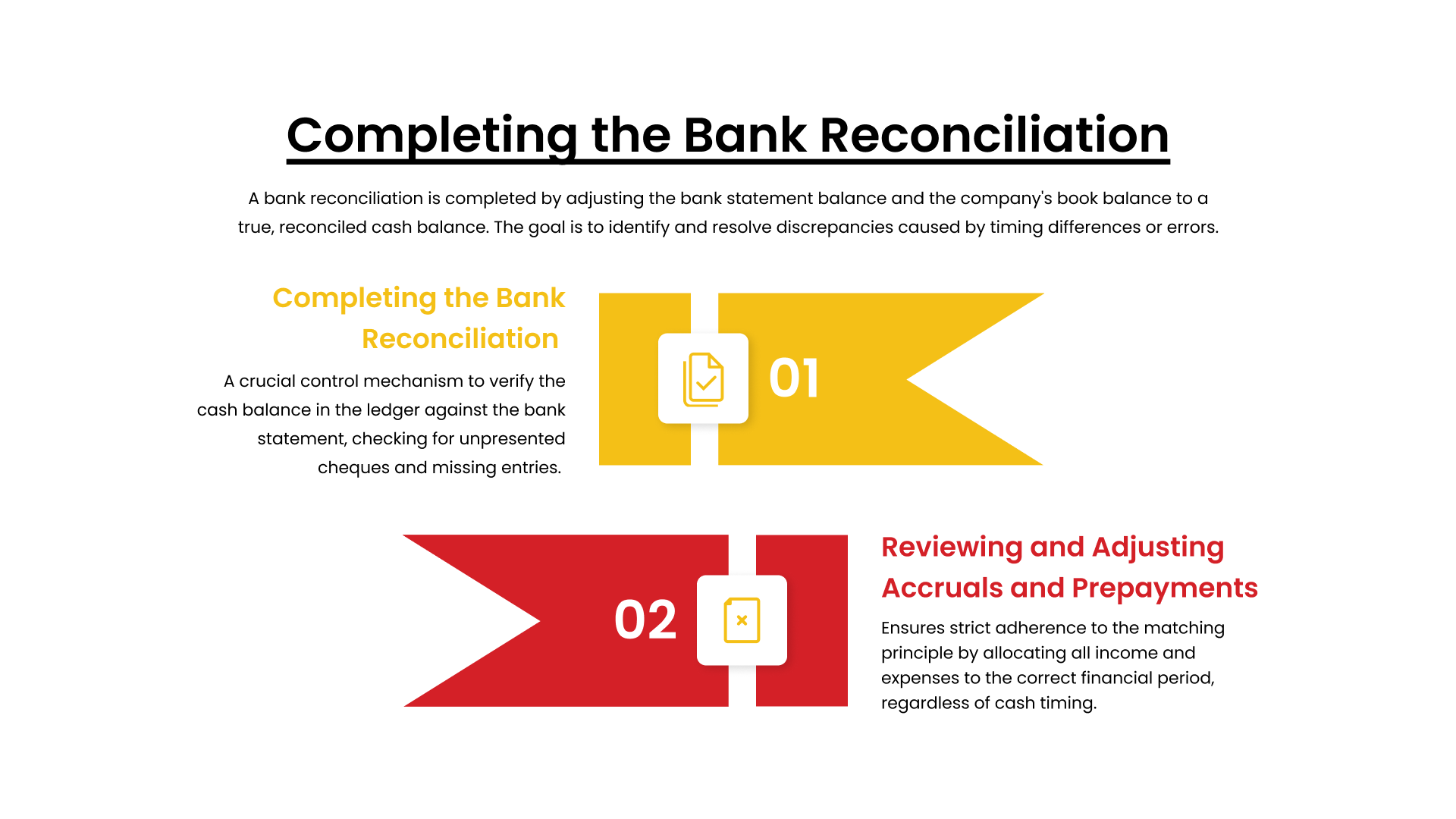
1. Completing the Bank Reconciliation
We perform the Bank Reconciliation precisely at the year-end date to verify the cash balance in your ledger against the bank statement. This is a crucial internal control mechanism.
Key Checks AZL Accountants Perform:
Unpresented Cheques: Confirming cheques issued by the company but not yet cleared by the bank.
Uncleared Deposits: Verifying deposits recorded in your books but not yet credited by the bank.
Missing Entries: Identifying bank charges, interest, or direct debits recorded by the bank but not yet in the company ledger.
2. Reviewing and Adjusting Accruals and Prepayments
This stage ensures strict adherence to the matching principle by allocating income and expenses to the correct financial period, regardless of when cash changed hands.
Understanding Key Adjustments:
Accruals: Expenses incurred during the current period but for which an invoice has not yet been received (e.g., unbilled legal services).
Prepayments: Expenses paid during the current period that relate to the next period (e.g., annual subscription paid in December for the following year).
3. Finalising the Accounts Payable Ledger
We confirm that all monies owed by the company to suppliers are accurately recorded, preventing an understatement of liabilities.
The Cut-Off Procedure: Our accountants verify that all supplier invoices relating to the current fiscal year are recorded before the cut-off date. This prevents the intentional or accidental understatement of current liabilities and the resulting overstatement of profit.
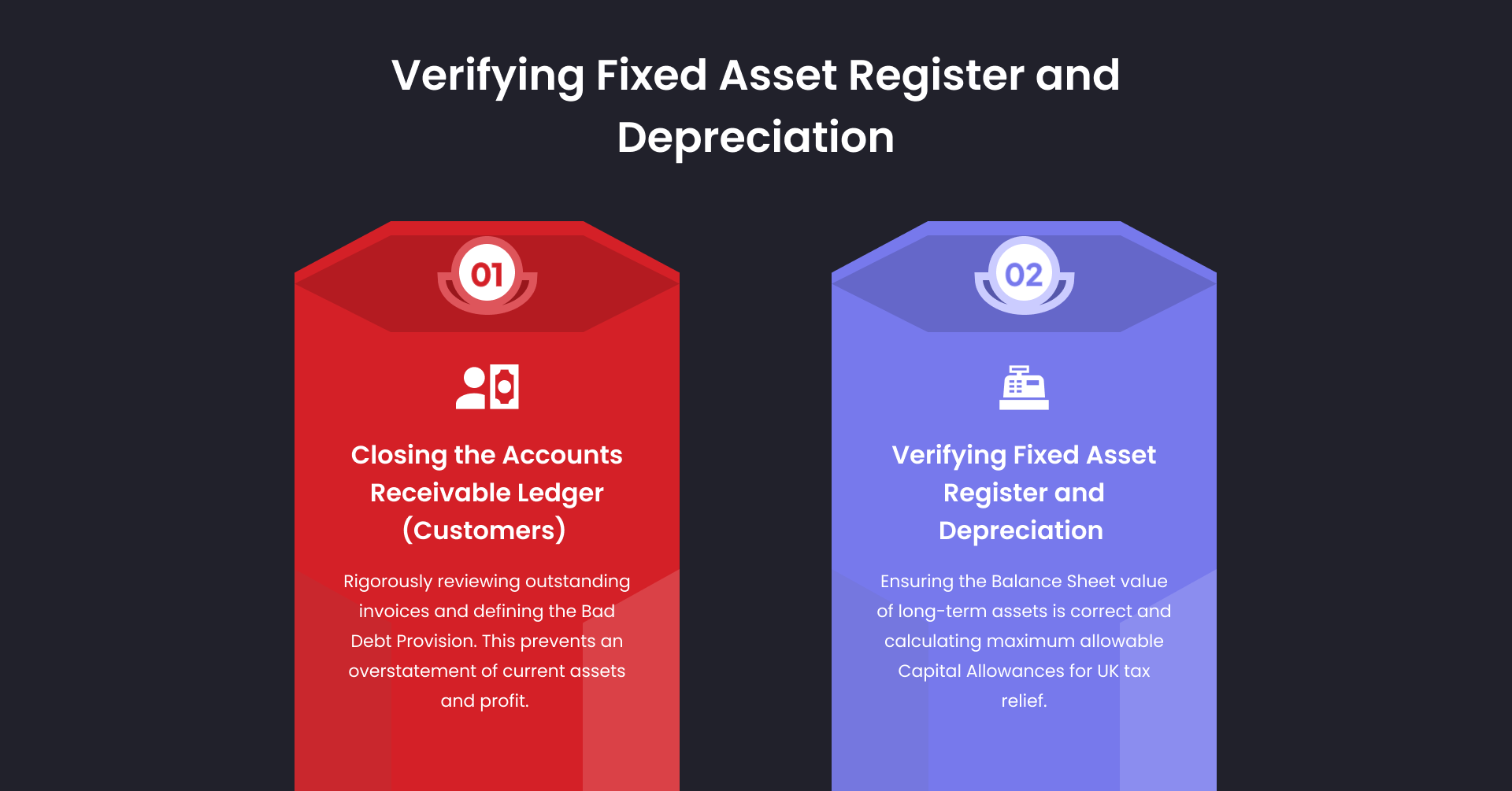
4. Closing the Accounts Receivable Ledger (Customers)
We rigorously review outstanding customer invoices to ensure the firm’s current assets (money owed to you) are correctly valued.
The Bad Debt Provision: We define and apply the Bad Debt Provision (or Allowance for Doubtful Debts). This prudent Adjusting Journal Entry estimates the amount of outstanding debt unlikely to be collected. Failure to implement a proper provision leads directly to an overstatement of assets and profit.
5. Verifying Fixed Asset Register and Depreciation
We ensure that the balance sheet value of long-term assets is correct and that maximum allowable Capital Allowances are claimed for UK tax purposes.
Fixed Asset Tasks AZL Manages:
Physical Verification: Cross-checking physical assets against the register.
Depreciation Calculation: Calculating and posting the final period’s Depreciation expense up to the year-end date.
Maximising Tax Relief: AZL guarantees that Capital Allowances (the tax equivalent of depreciation) are correctly calculated and maximised, legally reducing your Corporation Tax liability.
Final Review: The Essential 10-Point Checklist (6–10)
The second half of the checklist focuses on complex assets, liabilities, and the final Adjusting Journal Entries required to solidify the True and Fair View.
6. Stocktake and Inventory Valuation
For businesses holding inventory, an accurate count and valuation is mandatory for calculating the Cost of Goods Sold (COGS) and determining profitability.
The Valuation Principle: We apply the conservative accounting principle: valuing inventory at the lower of cost and Net Realizable Value (NRV). If the estimated selling price minus costs (NRV) is lower than the purchase cost, we correctly write down the value.
7. Finalising Payroll and PAYE Liabilities
All payroll activities and related liabilities must be reconciled and closed for the final period.
Reconciliation Requirements:
Control Accounts: Reconciling all payroll control accounts, including PAYE (Pay as You Earn), National Insurance (NI), and pension contributions.
Accrual: Ensuring all salaries, commissions, and bonuses relating to the period are correctly accrued before the close, regardless of the physical payment date.
8. Reviewing Director’s Loan Accounts and Equity
The Director’s Loan Account (DLA) is a communal area of intense scrutiny for small UK companies and must be verified against strict Companies Act 2006 regulations.
Compliance Verification: We verify the exact balance and nature of the DLA, ensuring any withdrawals are compliant or correctly classified as dividends.
Tax Focus: Our primary focus is on overdrawn accounts, as this can trigger immediate tax liabilities and reporting duties with HMRC.
9. Reviewing and Posting Adjusting Journal Entries
These are the final, essential entries required to present a True and Fair View before the books are officially closed.
Common Year-End Adjustments Required by AZL:
Final provision for estimated Corporation Tax.
Accruals for audit fees, interest, or expected legal settlements.
Adjustments for inventory write-downs or corrections to prior period errors.
10. Final Trial Balance Review and Materiality Check
This is the ultimate quality control step before final accounts preparation.
Trial Balance Reconciliation: We ensure the total Debits precisely equals the total Credits. We strive to locate any error before using a suspense account.
The Concept of Materiality: We check that all potentially significant entries—any that could influence the judgement of a reader of the accounts—are correct and free from misstatement, thus completing the clean close.
Partnering with AZL for a Seamless UK Year-End Close
The 10-point checklist provides the required framework, but our expert accountants deliver the crucial compliance verification and strategic financial advantage, specifically tailored for businesses operating in England and Wales.
AZL’s Expertise in Statutory and Tax Compliance
Our commitment is to provide definitive, up-to-date knowledge on UK finance, tax law, and accounting standards.
Final Accounts Preparation: We convert the structured data from this checklist into fully compliant, accurate Annual Accounts.
Intelligent Tax Structuring: We specialise in intelligent tax structuring advice, ensuring you claim maximum Capital Allowances and deductions legally available under UK tax law.
Complex Guidance: Our accountants are on hand to guide you through complex areas like Revenue Recognition, Bad Debt Provision, and DLA compliance.
Your year-end accuracy is our priority. Schedule a consultation with an AZL expert accountant now to secure a seamless, tax-efficient close for your UK business.
Law firm partners and practice managers across England and Wales face constant regulatory pressure. Managing Value Added Tax (VAT) correctly, especially regarding client fees and the accurate definition of a disbursement presents a major financial and regulatory exposure. Misclassification on an invoice...
Unidentified funds entering your legal firm’s accounts create an immediate regulatory and financial risk. In the highly regulated environment of England and Wales, where Solicitors Regulation Authority (SRA) Accounts Rules govern every transaction, a simple bank receipt with an unknown source can jeopardise your Trial Balance and compliance standing. Law firms require an...
For law firm partners and practice managers in England and Wales, managing client finances securely and compliantly presents a persistent, high-stakes challenge. The integrity of your firm hinges on impeccable financial record-keeping. You need clarity and confidence in every transaction, ensuring you satisfy the rigorous demands of the Solicitors Regulation Authority (SRA) while maintaining profitable operations. AZL Accountants provides the specialist expertise your firm needs....





 3 July 2026
 1 July 2026